Wednesday, September 05, 2012

"One box of YUMMY Triscuits"

Back when I was young and my parents thought fuelling my desires to travel the world was harmless, they gave me a copy of Dian Fossey’s book Gorillas in the Mist (For those unfamiliar with Ms Fossey, she studied gorillas in Rwanda).

My parents now probably now realise their mistake and wish they had showered me with more Mary Englebrecht, i.e. “Bloom where you’re planted,” and less Robert Louis Stevenson, i.e. “For my part, I travel not to go anywhere, but to go. I travel for travel’s sake.” But since the damage has been done, I notice they’ve stopped giving me books about travelling ... : )

Back on the subject, from her remote mountain location Ms Fossey sends a list home of all the supplies she needs for her camp. I don’t remember exactly what is on it; useful things of course: probably a generator or tents or something like that. I do remember at the top of the list she emphasises, “One Box of YUMMY Triscuits.” Toward the end of the list she reiterates, “Another Box of YUMMY Triscuits.”

It is the only line from the book I can quote - nay, even more: have repeatedly quoted. While travelling is my life, and exoticness the air I breathe, nonetheless, sometimes all I want is a box of YUMMY Triscuits, those woven crackers being - alas - all but impossible to find in the far-flung corners of the world. And sometimes in the near-flung corners, as well.

In the spirit of Ms Fossey, I have crafted a list of things I miss from home while living abroad. Not to be biased, a list of things I miss while living Stateside will follow.


Things from the U.S.A. that I miss while in Japan:

  • One box of YUMMY Triscuits
  • A real oven
  • Diet Pepsi (not something I drink often, but every now and then in the summertime)
  • English reading materials: books, magazines, local news, cereal boxes, etc.
  • Deodorant (I found Japanese deodorant doesn’t work for me, but luckily I knew that and stocked up before I came this time!)
  • Peanut Butter
  • Rooms (as in, an apartment with more than one)
  • A bed - not that we have anywhere to put one...
  • Halloween Oreo Cookies (David misses these, too!)
  • A clothes dryer
  • Another box of YUMMY Triscuits

Monday, September 03, 2012

Foray into Japanese whisky

Finally - we have begun!

Yesterday at the grocery store, David and I finally decided on which Japanese whisky to try first. We have been a little nervous, as most people are when confronted with the array of products listed under the umbrella term of “Whisky”.

It is daunting enough to face a row of Scotch in the store, but then take that feeling and put it into another language.

Add to that the little nagging voice in the back of my head telling me that Japanese whisky isn’t real whisky, like Scotch. Yet, I know - from distillery workers in Scotland, no less - that despite the disparaging review of Suntory in Lost in Translation, distilleries in this country have won several awards for taste and quality.

As it turns out, some distilleries exactly copy the craft of making Scotch - right down to ordering all their barley from Scotland. The only thing that makes their whisky different is that pesky little law stating that in order for whisky to be called “Scotch,” it must, in fact, be made in Scotland.

Lest you think I am dismissing the subtle differences of different types of whisky - or not so subtle in the case of Laphoraig - Japanese whisky is not Scotch whisky. It differs in flavour, as an Islay differs from a Speyside.

We managed, though, on our fist pick to find a great whisky.


Distillery: Nikka
Expression: Yoichi
Age: No age given
Price: 1400 yen ($17-18)

Verdict: I don’t go in much for all that “hints of citrus with a caramel finish” kind of talk - it’s all subjective anyway. What I will say is that I tasted a light smokiness and a little sweetness, but not very much. And it didn’t remind me of fruit when I drank it.

I would buy this again.

For more information on Yoichi whisky, see:
Nonjatta, a Japanese whisky blog
or
The Nikka distillery website

To enter the world of Japanese whisky, I found this to be a good introduction: Japanese Whisky Primer

Thursday, August 30, 2012

Harvest time

I pass this field on my way to work everyday. It's the field that reminds me I live in Japan (you know, just in case I forget). In May, the newly planted rice was amazing and exotic. In August it is no less amazing, although slightly more recognisable!

The fields as they were in May:

Here they are now; the farmers have already begun harvesting the rice:

Tuesday, August 28, 2012

Ending on high note

On the last day of summer vacation, I said, "Hey let's do something fun!" We ruled out a trip the States on account of my having to be at work the next day, but the local mountain was begging to be climbed. Tokushima is built around Mt. Bizan, and we had not yet been up it.

View of Mt. Bizan from our street.

"Into the woods and out of the woods and home before dark."

Halfway up.

It was about here that remembered I forgot the "911" number
for Japan. We were very careful not to get stung, bit, or
otherwise injured on our walk
(When we came down, I learned it. We'll be safe now).


The path up the mountain is lined with graves
 of Tokushima's Meiji-Era rulers (Meiji is late 19th century).


Looking out over the harbour toward Wakayama
Prefecture on the main island of Honshu.
Tokushima city. Can you see our house?
No?
Here, I'll help ...
There it is!


A Japanese symbol of summer: wind chimes!
I don't know why there were dozens of them
lining the stairway in the rope way ticket building,
but they are pretty, and I like listening to them.
Coming down we took the rope way.
It was much easier than the climb up.
After indigo dyeing, glassblowing, river walks, a trip to the beach, the Awa O-Dori festival, and a hike up a mountain, David is very, very glad I went back to work to he can rest.

Sunday, August 26, 2012

Summer crafting

You know that thing you’ve always wanted to do, but were afraid it’s too difficult/ hot/ dangerous/etc.?

Yes, I mean glassblowing. And it turns out, it’s not too anything, except maybe too much fun and I can’t wait to go back.

Of course, by “not too difficult,” I mean it was not too difficult to have the instructor helping me, hand over hand, while I desperately prayed not to drop the glass into the furnace.

And by “not too hot,” I mean the studio offered air-conditioned benches. In the picture of David, there is a grey tube pointed down his neck - that’s his own personal cooling system.

And by “not too dangerous,” I mean we were covered in heavy aprons and gloves and all manner of protective clothing.

The Tokushima Civic Centre operates a small glassblowing studio where anyone can take a try at making their own glassware. Or, if one prefers design over construction, the studio also offers sandblast etching, fused glass plate-making, and sand casts of your baby’s feet or paws.

I’ve long known glass making was in my blood. My grandfather worked until retirement for a glass factory which produces windshields. My great-great grandfather crafted blown glass items. Glassblowing is a family tradition I hope I will be able to continue to uphold.

This excursion was the highlight of summer vacation. A huge thank you to my co-worker Ikue both for taking us and for translating the tricky bits. And a huge thank-you to her mother who works at the studio and gifted us with the opportunity to create our fused glass plates.

When can we go again???

Monday, August 20, 2012

How to eat sushi in Japan

(Beware of parenthetical remarks (You have been warned.)).

1. Learn Japanese.
2. Go to a sushi restaurant.
3. Sit at the counter.
4. Order individually created plates of sushi created by a master chef specifically for you.
5. Enjoy the freshest, best fish in the world.

OR

How to eat sushi in Japan for poor people:

1. Learn Japanese (this step is more important than you might think).

2. Go to a fast-food sushi restaurant, where each plate is only 105 yen. It’s like a McDonald’s for sushi (except with computers! And a conveyor belt!).

3. Try to interact with the computer and tell it how many people are in your party.

4. Realise you didn’t actually do step one, and can’t figure out how to work the computer.

5. Flag down a hostess/waitress and have her do it for you.

6. Wait for your number to be called.

7. Because you’re a foreigner and are just excited about sushi, and requested, “First available”, your number will be called immediately (The choices are: “Booth”, “Counter”, or “First available”. No one else wants to sit at the counter, so off you go).

8. Sit down at counter.


9. Gawk as sushi rolls past on a conveyor belt.

10. Search for drinks.

11. Find cups on a shelf above your head.

12. Fill cup with water from spigot conveniently located on the counter in front of you.

13. Take a drink and burn tongue because it’s hot water for making Japanese green tea (Cold water not available (Soft drinks available upon interaction with a Japanese computer)).

14. Realise your dinner is passing you on a track, and you’re missing out on eating yummy sushi!

15. Reach for a plate, but too slowly. You have at most four seconds from recognising a fish until it is no longer in reach.

16. Decide now!

17. Do you want salmon?
17.1. Shrimp?
17.2 Tuna?
17.3 Roe?
17.4 Unknown white fish?

18. Arggh!

19. In the meantime, keep an eye on all the other diners, watching for protocol and what to do at the end of the meal, i.e. how to pay.

20. Notice that you’ve seen this sushi before. Deduce that the belt travels in a loop; if you miss one, another will be along shortly.

21. Relax and have fun trying new foods. Fish eggs ... No problem! Tomato-Basil Salmon ... Um, okay? Sea urchin ... Ugh, slimy. (Of course, the nice thing about sushi is: if you don’t like it, it’s only bad for one bite.)


22. Clear palate on a nice, safe, normal, raw salmon. (Yes, Japan has a tendency to redefine “normal”).


23. When you feel you have personally deflated the tuna population of the Pacific by at least 4%, attempt to flag down the waitress (Remember how you were watching the others diners to see how they ended their meal? No? Us, neither).

24. Stare helplessly at the Japanese computer on the counter in front of you (remember step one?). Will it to display something - anything - helpful. English would be nice. Or pictures. Maybe of a waitress coming to your aid.

25. Bang on the computer like a monkey trying to write Shakespeare.

26. Sooner or later, a waitress will notice your distress and come to your aid. That, or you accidentally called her 15 times.

27. Wait while the waitress whips out a ruler that is calibrated in “Plate Heights” and measures just how much tuna the ocean is now missing.


28. After she has scanned the bar code on her ruler at the appropriate measurement and your entry ticket, take the ticket to the cash register. This is your bill.

29. Pay for your meal.

30. Marvel at the sheer volume of sushi you can eat for a mere $25 (that’s for two people, folks!)

31. Waddle to your bicycle and hope you can make it home.

(The pictorial guide for this “How-To” post is woefully inadequate due to the abundance of yummy sushi. Perhaps we should go eat sushi again in the interest of quality journalism).

Sunday, August 19, 2012

A Day at the River

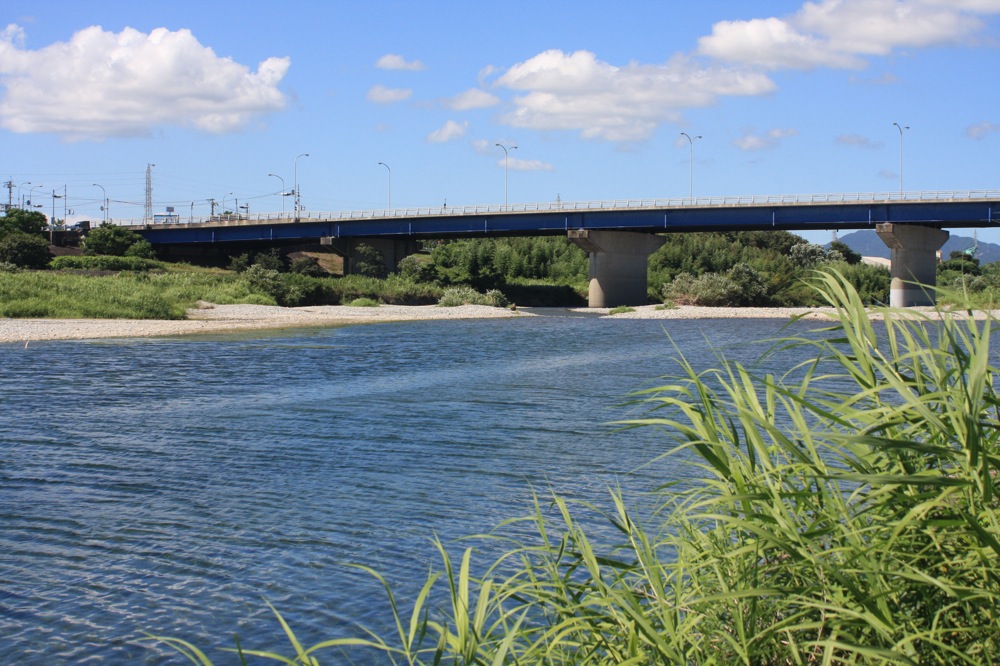
When I go to work, I cross this this bridge.
Today we decided to explore the river under the bridge.
It was a hot day, but good for a walk along the river.


David's rock photo.


I thought I was so clever taking a picture of a
dragonfly through the blades of grass.

Until David was taller than the grass and shot this.

Sigh.
So I had to take the camera back and try again.

This is the view on my commute.
Tokushima is beautiful. 

Japanese Tie Die

Truthfully, I thought it would be much harder than it was. I thought it would be different than it was. I thought ... well, I am not sure what I was expecting, but tie-dye wasn’t it.

Take a strip of cloth, tie a few knots in it, dip, and rinse.

Ummm .... I can do that at home without having to spend twenty dollars on bus fare.

Never mind that I haven’t ever done it at home, nor would have I thought of doing it at home. Indigo dyeing is a traditional Japanese craft best experienced in a room full of midnight-coloured vats, the smell overpowering all my good sense.

And then I realise, no - I couldn’t have done this at home. This is not commercial Rit Dye, this is the real stuff: made from fermented indigo leaves and lye and bits of various plant materials. It is dark, bubbly, deep, and it stinks (one website diplomatically calls the smell “distinctive” Umm, yes, that’s it...distinctive).

The dyeing was a lot of fun, so much so that I went back twice. Okay, we had mistakenly brought three cloths along to dye, and also had two hours until our next bus, but it was, indeed, a lot of fun.

The museum itself comprises four buildings edging a courtyard. In one long, dark building, small models of the indigo making process leads visitors on a tour from planting the seeds, through harvest, dye making, and dying cloth, and finally into the store for sale.

Tools occupied one building: including traditional leaf-gathering baskets and old vats and various leaf grinding machines.

The house of an indigo merchant is preserved for visitors to walk though. It is currently empty of all furnishings save one lone mannequin of an accountant taking notes of the indigo stock, but the house itself is full of rich details: Painted screens on closet doors and intricate woodwork almost impossible to photograph; light fixtures both western and Japanese; traditional tatami rooms surrounded by a wooden veranda; three sets of stairs led us us through a maze of rooms and hallways.

Even empty, there is a lot to see.
Stencil from the of Days of Yore.
Finally, into the dyeing rooms. There I learned how to make the different patterns for dyeing. Some knotting, some folding, some stencils (which were not available for public use), some helpful wooden tools (see below, when making the star on my handkerchief). I learned that the bubbles floating on top of the vat are actually a sign of healthy fermentation of the dye - not, as I wondered, dirty dye from hundreds of tourists. I learned that 90% of all indigo products in Japan are produced in Tokushima.

I learned that dyeing (though maybe not quite as fun as glass blowing) is still very fun.