Wednesday, June 13, 2012
How to Make Blonde Brownies in a Toaster Oven
I am considering changing the title of the blog into “Adventures in Toaster Oven Cooking.”
Blonde Brownies
0. Buy a tiny silicone cake pan.
1. Halve the recipe.
2. Melt butter and brown sugar (well, beige sugar) into a clump.
3. Add egg. Watch in horror as the realisation occurs that the pan isn’t cool enough. See egg cook as it hits the bottom of the pan.
4. Figure that butter is the most expensive thing in the ingredients, and since it’s unrecoverable at this point anyway, gamely go on.
5. Add flour. Lose count. Hope it’s not too much.
6. Add baking soda and baking powder.
7. Glob the mess into a small silicone pan.
8. Cover with tin foil so the top doesn’t burn.
9. Set temp to, oh, let’s say 160 Celsius. Wonder what that is in Fahrenheit.
10. Turn the “on” knob as far as it will go, which is 15 minutes. Come back every 15 minutes and turn again.
11. Take off tin foil when it seems the rest of the cake is far enough along.
12. Come back (again) in 15 minutes and realise it isn’t finished.
13. Burn fingers while reattaching tin foil to hot pan.
14. After another 15 minutes, give up, take the brownies out, and cut while warm, as recipe demands.
15. Turn brownies out onto cutting board, looking at the burnt bottom and uncooked, gooey middle.
16. Eat half the pan out of spite.
17. Go to bed. Try again tomorrow while dunking the rocky edges into your coffee to soften them up enough to not break your teeth as you gnaw on them.
(As a side bonus, you just learned how to make dwarf bread).
Thursday, June 07, 2012
Teaching in Japan, Part 1
I have been trying to write an entry about teaching in Japan. However, I had a question about how long English has been taught in junior high here. In the midst of looking for the answer, I got sucked into Japan’s complicated history with the United States. What I ended up with is a three part series on the history of English study in Japan and where I fit into that today.
It’s not near enough to be a full report of history, however, I hope there is enough information to teach, without too much extraneous data.
Part 1: A (very) truncated history of English curriculum in Japan
Students begin English lessons in junior high school. In fact, English has been taught in Japanese junior high schools on and off since the late nineteenth century.
In 1853, Japan opened its doors for trade with the United States.* It was a one-sided trading agreement, severely limiting Japan’s negotiating ability. The Emperor decided the best way to overcome the inequality was to introduce English language learning. Scholars were sent abroad to learn English and classes were implemented four times a week at the junior high level.
Then, in 1924, the U.S. passed a law barring all Asians from immigrating to America. The English language curriculum fell out of favour in Japan, and was discontinued completely around the start of World War Two.
Junior high English classes re-appeared after the war. They’ve been a component of the Japanese education system ever since. Taking a cue from South Korea, English classes have recently been introduced in elementary schools one a once or twice a week basis.
*That’s a nice way of saying it. It such a nice way of describing the incident that it’s almost a lie. However, as the end result of Matthew Perry’s 1858 visit to Japan was, indeed, trade relations between the U.S. and Japan.
In the interest of being brief, I left out many interceding decades. A more complete timeline be found in the article “Globalization and the History of English Education” in the Asian EFL Journal: http://www.asian-efl-journal.com/Sept_06_nfa.php
Other sources for this article are:
The U.S. Department of State Office of the Historian:
http://history.state.gov/milestones/1921-1936/ImmigrationAct
Other various articles on English education in Japan:
http://web.iess.ehime-u.ac.jp/raineruto1/02RD2.pdf
http://www.cis.doshisha.ac.jp/kkitao/library/article/tejk.htm
Part Two: English learning today
The one thing any junior high foreign language curriculum lacks is adequate conversation time. I remember learning German in high school, which was great. However, I couldn’t practice German outside of class - with whom would I speak? I could write sentences, read, and learn grammar, but I would not learn how to pronounce it other than three hours a week.
Japanese students learning English are no different. So, although almost everyone in Japan has looked at an English textbook once in their life, if you ask them “Do you speak English?” they will say no.
The first difficulty in getting written English off the page and being spoken comes from all the extra letters English contains. In Japanese, V and B are the same sound. The same goes for L and R and a handful of other letter pairs.
This is only the start, as English words rarely sound like they look, and the trouble of F, ph, and gh sometimes all sharing the same sound is well-ridiculed in English, the most famous being the word ghoti being an alternative spelling for fish. A simple Google search, though, returns many rhymes and jokes based on English spelling’s aversion to consistency.
Japanese teachers of English have studied very hard over the years to get this pronunciation correct. Or, they have not studied it so much and feel inadequate to teach it. Hence, many English classes in Japanese schools focus only reading and writing.
Many solutions have been offered to teach English pronunciation. You may have heard of the JET program, in which native English speakers are hired by the Japanese government to teach English in junior high and high schools in conjunction with the native Japanese teacher. Also, Christian missionaries have come to Japan with the purpose of teaching English in addition to their evangelising. That is what took me to Tokyo in 2005.
Another option is for a Japanese student to find a native speaker and strike up a conversation. Since walking up to a stranger in the grocery store is difficult and uncommon (although not unheard of, as a man approached David and I just last month with the proud news that he had been on a language study tour in Canada), there exists in Japan an institution called the Eikaiwa. An Eikaiwa is a private English school teaching conversation skills.
Ei, means "English."
Kaiwai means "conversation."
Eikaiwa.
Students who spend all day studying and adults who spend all day working go in the evenings or on weekends to learn conversation skills from a native teacher. This is where I work now.
Part 3: What I do in Japan
My students are 2-year-olds who barely speak Japanese, let alone English. They are active elementary students who have been studying English for one or two years already. They are junior high students dutifully learning English from their state-approved textbook. They are adults wanting to watch movies from Hollywood without subtitles and trying to become proficient speakers.
The point of an Eikaiwa (see above article) is to give people a place to speak a language they aren’t able to use in their everyday lives. Some adults want to retain language learned while living abroad, but have no chance to speak English once returning home. Others want to become fluent speakers for travel or business purposes.
Parents often want to give their children an early start at learning a language they will need once they get to junior high. They know the difficulties in learning language at that age, and how much easier it is to learn when they are young.
With the children, we "run" and "dance." We "jump" and "swim." We count and sing and identify fruits, vegetables, and animals. We learn grammar (an apple, grapes, a cat). With the adults, I also teach grammar, albeit slightly more advanced (i.e. What have you been doing?). We talk about current events - the eclipse was a fun topic. We practice sentence patterns in the form of a "Grammar Rap." Don't worry, it' is not near as bad as it sounds!
All of the students, but especially the children put me to shame. I am embarrassed by my lack of a second language. Sure, I studied a little German and Japanese and a smattering of Spanish, but I am not fluent in any of them. I have long been a proponent of teaching Spanish to children in the United States from a very early age and making it mandatory in schools. It not only easier to learn when they are young, but it paves the way for the elective foreign language they will choose of their own accord in junior high, as it becomes easier to learn a third language than a second. Being bilingual allows people more career opportunities than being monolingual. Not least of all, it opens up communication to more people and and enables the speaker to be a better global citizen.
For all of these same reasons, Japanese parents bring their children to me. 50 minutes, once a week. It isn’t much. It really isn’t even enough. But it’s a start. Therefore, I do my best to nurture the students in this global society.
Wednesday, June 06, 2012
Tokushima Sky
Sometimes I am depressed by the sky in Tokushima, those days when it is a single washed-out grey/white colour without depth or character. More often than anywhere I have experience, this flat dull sky hovers, mocking me, making me wish for the ever-changing mid-west sky.
But then, after a spectacular wind and lightening show, the clouds billow up above the mountains, allowing the mountain tops a chance to play hide-n-seek with the sky. The orange temple roof and nearby green of treetops are made even more vibrant against the black clouds. The colours are sharp and the sites are hazy in the mist and fog of a Tokushima storm.
Then I remind myself not to be too hard on Tokushima. The sky may take its time, but when it opens up, it is breathtakingly beautiful.
Monday, June 04, 2012
School Excursion: Tokushima Zoo
What looked to be a rainy day turned into a sunny day.
What looked to be too difficult a Scavenger Hunt turned into too easy a Scavenger Hunt.
What looked to be chaos turned into a fun day at the zoo for the UI students.
What do I say about a school field trip to the zoo?
There were children.
There were animals.
There were people dressed up as Japanese cartoon characters.
(Not our students or parents - it was a show put on at the zoo. Don’t ask me what it was about, because I didn’t understand).
It was pretty much everything one would expect from a school field trip, in Japan or anywhere!
Everyone had a great time, although almost everyone was finished with the scavenger hunt before lunch. As far as I can tell, no one was tripped up by the “Bird that sleeps during the day,” even though the duck was sleeping and the owl was awake. And many people were wearing striped shirts, so I waited for one them to turn themselves in as “An animal with stripes.” No one did.
On the other hand, I did not expect to sit down with a three-year old who sang “One little, two little, three little monkeys,” for me. He got tripped up at eleven, but heroically picked up again with fourteen and was up to nineteen before getting distracted by the people dressed up as Japanese cartoon characters. I really don’t know if he would have stopped at twenty or just kept going until I had to leave.
There were stickers and candy for the winners - which was everyone, not out of “fairness”, but because (as I mentioned) I needed to be tougher with my clues. Ah well. Next time.
| Before beginning - explaining the rules and reviewing the English. |
![]() |
| An animal from Japan. Check! |
| Lunch break - a game of tag and catching tadpoles. |
![]() |
| The restaurant we ordered lunch from included an English word game in the lunch boxes for us: Which word is different? |
| Everyone received stickers because everyone finished the scavenger hunt. |
| Handing out candy to one very smart three-year-old. |
Firefly Festival
We had barely gotten home from the zoo and fallen into bed for a nap when the phone rang. Our landlady had invited us to a firefly festival on June 9. Discovering the festival was June 3, she hurriedly called and changed our outing, and could we still make it?
Two excursion in one day? Oh, why not?
In the end, the evening was too cool for fireflies, and the turnout was less than she had hoped. But, we did watch an amazing fire dance, so I am breaking my self-imposed “2-3 photos per post” rule in order to lavish you with fire.
There is talk about going back next weekend when the weather is expected to be more cooperative, and consequently the fireflies, too.
![]() |
| Fireworks Finale! |
Monday, May 28, 2012
Jellyfish!!!
![]() |
I am from Iowa. I was one month away from college graduation the first time I saw an ocean. David is from Montana. He, on the other hand was three the first time he laid eyes on the foaming brine. Not that he remembers it.
Now we live on an island. Rivers criss-cross Tokushima and are connected to the ocean at at much nearer distance than any where we grew up. Near enough to have dozens of jellyfish wash in with the tide.
We sounded like school kids on a field trip: heads hung over the railing, squealing sounds of delight (okay, that was me, not David), and taking photos with abandon. Thank goodness for digital cameras!
| This type of jellyfish is called a moon jelly. |
As if a horde of jellyfish wasn’t enough, we also happened across what appears to be a stingray. They are common in the ocean all around Japan, and often found in shallow water near the coast. It was awesome!
I’ve not had a chance to learn how to take photos into the water. I had no idea what was doing. Please forgive the quality - but they’re jellyfish!! I could not contain my excitement earlier, and I am still (several hours later) giggling over seeing jellyfish and stingrays. Today is the first time I’ve ever seen them outside of an aquarium. And it was without a doubt the coolest sight I’ve seen since coming to Japan.
What an amazing day!
Sunday, May 27, 2012
Making Tortillas
We were utterly spoiled when we lived in Chicago. We had our choice of great tasting tortillas - and some not so great ones as well. David likes tortillas, but I love them. I eat them instead of bread for grilled cheese sandwiches, breakfast (with peanut butter), desert (with yummy chocolate spread!), a snack (with peanut butter and yummy chocolate spread), not to mention in their more expected place around tacos and enchiladas.
I had learned to make my own tortillas in Tokyo when I discovered how difficult they were to find, and just how expensive they were after finally locating them. A flour tortilla recipe only called for flour, salt, shortening of some sort, and water. It was much easier just to make them myself. And they tasted better than any I had ever bought.
![]() |
| Cooking up some flatbread goodness! |
When I moved to Chicago, however, the opposite happened. They were locally made, delicious, and cheap, so I stopped making my own. By the time David came around, I had long since believed my tortilla making days were over.
Then we moved to Tokushima.
Somedays I am not sure what prompted a move back to a country that doesn’t value the tortilla as a staple food. Japan has many good qualities, but undervaluing the tortilla is not one I understand.
Tonight I tracked down a new recipe for flour tortillas - mine was long ago rejected from the recycle bin for being too well-used and covered in oil, and like a pizza box, my recipe was consigned to the trash. I found a new recipe, a better one than before, and I made tortillas for the first time in four years
Heavenly: warm and soft. Fresh.
Just the way a tortilla should be.
Forgiveness in the Rain
I dislike riding my bicycle in the rain. I would rather walk and carry an umbrella than ride and feel like I have no protection. Often, the umbrella is a placebo anyway, as the wind is so strong as to make carrying the umbrella useless, or even counter-productive.
Since it was starting to dribble when I left for work on Friday, I grabbed my umbrella and began to walk. The wind wasn’t blowing so I was enjoying the cooler weather, if not the humidity.
My work schedule is a rare paradise in workplaces. I have the guilty pleasure of being able to I go in when I have work to do and leave when I am finished. All my Friday classes had already been planned; I left right around 2:30, solid in the knowledge that I’d still be an hour early to do any last minute changes and to set up the classroom.
I was two blocks from home when I remembered.
A new student was scheduled to begin class that day. With me. At 3:00. Even had I been riding my bike, at that point, I would not have made it to school before three. Panicked, I called my boss and explained the situation. I figured I could be there almost on time if I ran home, retrieved my bicycle, and hightailed it the work.
Her grace and forgiveness calmed and soothed me as she said, “I’ll come get you.”
In the chaos of setting up a new student, especially one whose work schedule is as varied as mine, uncertainties always creep in. There had been a question of whether she would begin this week or next, and at what time. In the end, 3:00 on Friday was decided. I wrote it down in on place, but not on the schedule at work. I felt only a little relief I managed to remember before class started. I should have remembered before leaving the house.
Yet, my boss offered more than mere forgiveness, which is enormous in itself. She came in her car to give me a ride, and we arrived at the school at 3:00 on the dot. No one (but the world of blog readers) was any the wiser of my mistake.
People ask why I picked Tokushima as the place to live and work in Japan. My boss is why.
Wednesday, May 23, 2012
Update
There is only one carrot left in the fridge. There are two carrot cakes in the freezer. My landlady has her cake. I've got one to take to work. There's still one sitting out to be eaten.
And yesterday we ate carrot jam for lunch.
I wish someone would start harvesting chocolate chip cookies.
![]() |
| Tower of Cake! |
![]() |
| David's lunch, with my carrot cakes in the background. |
Sunday, May 20, 2012
Carrots
Since we live in Japan, where ovens are non-existent, the biggest tool I have for making cakes and cookies is a toaster oven. Last month I bought two miniature loaf pans. Those loaf pans have already contained four loaves of carrot cake each. They are currently gearing up for another round because I live in Tokushima.
Tokushima has carrots the way the ocean has wet. It doesn’t really matter if you like it or want it. Carrots are going to appear on your doorstep.
Imagine going to the grocery store with your plastic grocery bag (I know, it’s not very eco-friendly, but at least you are re-using it). You take your grocery bag to the produce aisle and fill it with carrots. Three times. In two weeks.
David and I have eaten raw carrots, stir-fried carrots on rice, carrots in minestrone soup, a few more carrots on rice. We put some in the freezer. And of course, I made carrot cake. I gave one to everyone we know: my boss, my co-workers, our landlady, the Jehovah’s Witnesses who came to the door. Everyone.
![]() |
| What's left after the third batch has been eaten for dinner. And lunch. And snacks. Now it's time for breakfast. Yummy carrot cake! |
It’s now the middle of May, The fields are empty or full of newly-planted rice. I was even informed by my boss that carrot season is over.
Then last night my landlady thanked me for the delicious carrot cake. Another bag of carrots appeared. And she smiled.
I need to go buy more eggs.
Friday, May 18, 2012
The New Phone
A week ago David and I bought a cell phone. We bought the cheapest possible cell phone plan, since you all know how much David and I both love to talk on the phone. We also bought the cheapest possible phone. It’s one of those so-called smart-alek phones, and didn’t come with an instruction manual. Then again, the manual would have been in Japanese and less than helpful. I need all the help I can get trying to use the thing.
The other day my boss called and I couldn’t figure out how to answer the phone. Every now and then a light will blink in the corner; sometimes it’s red, sometimes green. I have no idea what it means. When I am trying to explore the various icons and what they do, I’ll change the look of my phone and be unable to put it back. The good news is we have no data plan, so I can’t run up any charges from accidentally hitting the wrong button. Argh! I’m not a fan of this phone.
This so-called smart-alec phone will be useful, though when we get internet. When that happens, David will do some magic and I’ll be able to call the United States. And you’ll be able to call us. And get this - it’ll be just like calling us in Montana. Won’t that be great?
But the best part of our new phone? Yesterday David discovered how to watch television on the phone. Television! On our phone! And it even records programs for later viewing, which will come in very handy today when, say, I’m at work during the sumo tournament.
Maybe I’m starting to like this smart-alek phone idea.
Saturday, May 12, 2012
How do you know you're in a foreign country?
I was thinking yesterday about living in a foreign country. When I go to the grocery store, I don’t know what most of the things on the shelf are. Or if I have a general guess, such as, “That’s a sauce,” I still do not always know exactly what kind of sauce. Yet, whenever I go, I’m just grocery shopping. It doesn’t feel strange. There may be crates of fresh squid and other such sea creatures in the meat department, but it’s still just a grocery store.
Also, last week David and I opened a bank account. It was a very long process, and my little bit of Japanese was not good enough to make things progress smoothly. We had to struggle between Japanese and English and I quickly learned how to write my address in Japanese, which I hadn’t done yet. But, all in all, it was just like any other trip to the bank: sitting at a desk, filling out form after form, dealing with the tedium, and having someone try to sell us the bank’s credit card.
Then yesterday, on the way to work, I looked out over the fields that had been empty the week before. During the Golden Week holidays when I didn’t go to work, the farmers were busy. The whole walk to work is now lined with freshly planted rice fields. Suddenly I felt the exoticness of Japan rushing up into me.
It isn’t the language or the billboards I can’t read. It isn’t the unidentifiable food in the stores. It isn’t the multitudinous garbage and recycling schedule. It isn’t the children in their school uniforms including matching hats and high-viz yellow backpacks glowing behind them. But when I look at the rice fields with their dainty green stalks rising up out of the water, I immediately feel as if the earth has shifted under my feet. Wait, where am I? Oh, right - I am far away from home in a foreign country.
![]() |
| You're not in Iowa anymore! |
![]() |
| My walk to work. |
Golden Week 2012
During Golden Week, Japanese students (and many non-students) enjoy a week-long vacation. A collection of four holidays happen in a span of seven days, giving people a nice break to get spring cleaning done before summer sets in, hot and humid. Well, David and I cleaned the apartment; my students took trips to Osaka or somewhere else nearby.
One day, though, we did get out and have a fun afternoon. The school I work for is planning an excursion to the zoo next month. To help plan a scavenger hunt, David and I accompanied my boss and another teacher to the zoo yesterday on a fact-gathering mission.
![]() |
| Tanuki. I might have a new favourite animal! |
Fact: The Tokushima zoo has many more different kinds of animals than I expected.
Fact: A native Japanese forest dweller, a tanuki, which is usually translated into English as “raccoon dog”, truthfully looks like a cross between a raccoon and a dog.
Fact: One black bird with white polka dots reminded me of a dress Lucy Ricardo wore.
![]() |
| What's the real name of what I call the "I Love Lucy Bird"? |
Fact: The four of us had as much fun at the zoo as we hope the children will have.
On the way back from the zoo, we stopped at Japan’s smallest mountain, called Bentan San. A shrine at the top of the mountain is dedicated to the goddess who created Japan. Her name slips my mind, but I’ll let you know when it comes back to me. It is a mound of trees sitting in the middle of vast fields, so it certainly doesn’t fit the terrain.
![]() |
| Bentan San |
Saturday, April 21, 2012
Cherry Blossom Viewing
It’s one of those things that just doesn’t translate well: Hanami. Literally meaning, “Look at flowers,” the concept of Hanami embodies much more than a stroll through a garden. Last Sunday David and I went with Kazuyo, my boss, to a park called Kamiyama. There we joined dozens of families having picnics, playing games, and enjoying a day out in the beautiful sunshine.
It looked like any Sunday outing, with one major difference: the sheet of pink above our heads. Japanese cherry blossom trees in bloom are like no other colour. They aren’t the dark pink of tulips. They aren’t the garish hot pink of a nine-year-old girl’s bedroom. For one very brief moment in spring the whole country of Japan is the soft shade of a baby’s blanket. But babies are small; hence their blankets are small. Early April in Japan is the only time I’ve ever seen such an unbroken line of baby pink.
The school year in Japan begins during cherry blossom season. The promise of new life and fresh flowers carry over into the promise of a new school year with fresh opportunities to learn and grow.
Cherry blossoms represent the life cycle in miniature. They bud, flower, and whither very quickly in early spring. Since their peak time for viewing is very, short cherry blossoms also represent a fleetingness in life. So, for one day, people take time out of their busy schedules. At the height of the blooming, families and friends pack up picnic lunches and have a party under the trees.
Hanami doesn’t translate well into English. Yet the concepts of taking a break from overly busy schedules, enjoying beauty in nature, and celebrating life cross national boundaries. Maybe we should find a word for Hanami in English. Along sakura (cherry blossom) road.
David's picture of sakura.
David and I with Momo, my boss' dog.
It looked like any Sunday outing, with one major difference: the sheet of pink above our heads. Japanese cherry blossom trees in bloom are like no other colour. They aren’t the dark pink of tulips. They aren’t the garish hot pink of a nine-year-old girl’s bedroom. For one very brief moment in spring the whole country of Japan is the soft shade of a baby’s blanket. But babies are small; hence their blankets are small. Early April in Japan is the only time I’ve ever seen such an unbroken line of baby pink.
The school year in Japan begins during cherry blossom season. The promise of new life and fresh flowers carry over into the promise of a new school year with fresh opportunities to learn and grow.
Cherry blossoms represent the life cycle in miniature. They bud, flower, and whither very quickly in early spring. Since their peak time for viewing is very, short cherry blossoms also represent a fleetingness in life. So, for one day, people take time out of their busy schedules. At the height of the blooming, families and friends pack up picnic lunches and have a party under the trees.
Hanami doesn’t translate well into English. Yet the concepts of taking a break from overly busy schedules, enjoying beauty in nature, and celebrating life cross national boundaries. Maybe we should find a word for Hanami in English. Along sakura (cherry blossom) road.
David's picture of sakura.
David and I with Momo, my boss' dog.
Monday, April 02, 2012
The First Week
This is from March 28th. I'll post it today, even though it's not current. I don't have anything current, but soon.
We arrived one week ago today. I think we’re mostly getting switched over to a 16-hour time difference. I’m sleeping through the night now, although come around the middle of the afternoon, I’m ready for bed again.
Tokushima is Japan. Everything I remember about Tokyo, with fewer people. The same type of buildings, the same restaurants, the same advertisements I can’t read. The difference comes in its surroundings. Where as I lived in the heart of Tokyo, and rarely saw greenery, Tokushima is at the base of Mount Bizan, and is surrounded by fields of vegetables. Most of the students’ families have either large gardens or farms. In the few days I’ve been at the school, I’ve received spinach, carrots, cabbage, and broccoli more than David and I could ever eat.
And then there’s the bicycle. I don’t cycle. Everyone who knows me knows I will walk for an hour to avoid cycling for 15 minutes. When that hour long walk is at night, even in a safe country, I am a little hesitant. Mainly because at 9:00 at night, I just want to be home in bed! So, I’ve been biking to work. And I’ve only fallen into one field (don’t worry, the field hadn’t been planted yet), and been the bane of only a dozen or so cars.
But, then, I’ve only biked to school twice. I am sure I’ll find many more people to run over as they days progress.
We arrived one week ago today. I think we’re mostly getting switched over to a 16-hour time difference. I’m sleeping through the night now, although come around the middle of the afternoon, I’m ready for bed again.
Tokushima is Japan. Everything I remember about Tokyo, with fewer people. The same type of buildings, the same restaurants, the same advertisements I can’t read. The difference comes in its surroundings. Where as I lived in the heart of Tokyo, and rarely saw greenery, Tokushima is at the base of Mount Bizan, and is surrounded by fields of vegetables. Most of the students’ families have either large gardens or farms. In the few days I’ve been at the school, I’ve received spinach, carrots, cabbage, and broccoli more than David and I could ever eat.
And then there’s the bicycle. I don’t cycle. Everyone who knows me knows I will walk for an hour to avoid cycling for 15 minutes. When that hour long walk is at night, even in a safe country, I am a little hesitant. Mainly because at 9:00 at night, I just want to be home in bed! So, I’ve been biking to work. And I’ve only fallen into one field (don’t worry, the field hadn’t been planted yet), and been the bane of only a dozen or so cars.
But, then, I’ve only biked to school twice. I am sure I’ll find many more people to run over as they days progress.
Tuesday, March 20, 2012
March 19, or is 20?
All in all, I must admit there are worse places to spend the night. The International Terminal at the San Francisco airport is quiet, practically empty. The night cleaning crew is here, making the rounds, and a flight to Singapore left around 1:00 am. Since then at least I have managed a couple hours of sleep.
We are camped at an unused gate, sprawled on the floor. Then again, all the gates feel unused right about now - we had our pick of floor to sleep on. I’ve never been in an airport so quiet, so deserted. If it weren’t for the fact that no one has tried to kick us out, I’d think the place was closed for the night!
And then a luggage cart will slink past out the window.
Someone is going somewhere.
Wherever they’re going, it is not Japan. The next flight to Japan is the one we will be on to Osaka at 11:30 tomorrow morning. Or is that today already? The next two flights to Tokyo leave shortly thereafter.
So much for trying to hop an earlier flight. We’re on the earlier flight!
We are camped at an unused gate, sprawled on the floor. Then again, all the gates feel unused right about now - we had our pick of floor to sleep on. I’ve never been in an airport so quiet, so deserted. If it weren’t for the fact that no one has tried to kick us out, I’d think the place was closed for the night!
And then a luggage cart will slink past out the window.
Someone is going somewhere.
Wherever they’re going, it is not Japan. The next flight to Japan is the one we will be on to Osaka at 11:30 tomorrow morning. Or is that today already? The next two flights to Tokyo leave shortly thereafter.
So much for trying to hop an earlier flight. We’re on the earlier flight!
Monday, March 19, 2012
Great Expectations
Looking forward to leaving tomorrow, I wonder what to expect in Japan. Having lived in Tokyo, I suppose this post seems like cheating. However, even though I will be in the same country, this time is a whole different situation. A new city. A new island. A new husband. A new type of school. Whether or not I expect things to be the same as they were in Tokyo, I know life will be different.
I hope for a one-bedroom apartment with a decent kitchen. I expect a studio with one burner in the corner.
I hope for a perfect job. I expect to be daily challenged and sometimes have bad days.
I hope the grocery store is near the apartment. I expect to trudge there on my bike and ride back with a backpack full of cans and jars.
I hope to travel all over the country, seeing Kobe, Hiroshima, Himeji, Fukuoka. I expect I will be too busy with work, too tired to travel, and too broke to afford many trips.
I used to hope we would live close enough to work that I would be able to walk. Then I spoke with my boss and learned a bike comes with the job. For good reason. Now I just hope the roads between the two places are flat!
I expect to be overwhelmed by the Japanese and the unfamiliarity of the television once again. I expect to stumble over my words, desperately trying to remember the language I have forgotten. I expect to find stress living somewhere slightly familiar to me, but not to David. I expect to be thrown off balance by the differences between Tokyo (pop. 8 million) and Tokushima (pop. 200,000).
What to expect? Usually, I try not to expect anything, so as not to be disappointed. Realistically, of course, I always expect to be happy and for everything to go my way. Or unrealistically. Either way, life goes on, and I enjoy the adventure.
I will not be in expectation much longer.
The adventure begins.
I hope for a one-bedroom apartment with a decent kitchen. I expect a studio with one burner in the corner.
I hope for a perfect job. I expect to be daily challenged and sometimes have bad days.
I hope the grocery store is near the apartment. I expect to trudge there on my bike and ride back with a backpack full of cans and jars.
I hope to travel all over the country, seeing Kobe, Hiroshima, Himeji, Fukuoka. I expect I will be too busy with work, too tired to travel, and too broke to afford many trips.
I used to hope we would live close enough to work that I would be able to walk. Then I spoke with my boss and learned a bike comes with the job. For good reason. Now I just hope the roads between the two places are flat!
I expect to be overwhelmed by the Japanese and the unfamiliarity of the television once again. I expect to stumble over my words, desperately trying to remember the language I have forgotten. I expect to find stress living somewhere slightly familiar to me, but not to David. I expect to be thrown off balance by the differences between Tokyo (pop. 8 million) and Tokushima (pop. 200,000).
What to expect? Usually, I try not to expect anything, so as not to be disappointed. Realistically, of course, I always expect to be happy and for everything to go my way. Or unrealistically. Either way, life goes on, and I enjoy the adventure.
I will not be in expectation much longer.
The adventure begins.
Saturday, March 17, 2012
Photos from packing
Tuesday, March 13, 2012
Throwing Away Memories
It is a relief to discover today is only Tuesday. I was afraid that yesterday was Tuesday, or perhaps Thursday. I guess if I were in an office staring at a computer all day praying for Friday, my attitude would be a little different. However, yesterday I stood, sat, knelt in a pile of my memories. My favorite books, my birthday cards, every letter sent to me by our German foreign exchange student in high school, several books of MadLibs, a present from my best friend, the program I bought when I saw Phantom of the Opera on Broadway, my elephant collection, my sumo newspaper clippings and books.
I sat in the middle of this timeline explosion, and nearly cried. My grandma’s nativity set. Too big to take to Japan, too old and broken to give to the thrift store. No one’s going to buy a nativity set where the wise men are missing hands, and the heads have been glued back on three times. Joseph is missing his staff. Or, is it a shepherd? Or, more likely, both of them. The angel sits skewed on her nail, and a two dimensional Jesus is the only one who hasn’t been chipped, safely painted into his manger. Into the garbage it goes, then.
All of my books. All except the Japanese language books I’ll need and two novels for the plane ride. I expect to obtain an e-reader in the near future, so I am not concerned with letting go of my H.G. Wells and Ursula LeGuin collections. They’re my favorite authors, but the books themselves mean little to me. However, the book Leanna gave me in high school I still have, complete with illustration she drew and has hung on my wall everywhere I have ever lived. The drawing can stay with me. The book is currently hidden under others going to the library in an attempt to make me forget it’s there.
Once I dreamed of having a home from which I travelled the world. I would go all over, see many things, and return to my bed and my pillows. My house would have photos on the walls and souvenirs of the places I visited. My dream home has morphed over the years, sometimes imagined as a large two story Victorian, sometimes a small apartment. Sometimes brick or stone, sometimes stucco or painted a pale yellow. But I had always figured I’d find a home base. It has finally occurred to me, after starting over three times in the U.S., that I don’t operate that way. I don’t go overseas to visit. I go overseas for a year. Or two. And this time, maybe for much longer.
I’m a nomadic, nostalgic packrat. I don’t keep things just to keep them. Each one has a story behind it. The Isabel Bloom statues given to me as a high school graduation present from my history teachers (yes, both of them each gave me one). The “warm fuzzy” given to me by a girl named Jodi when I learned that I would be leaving summer camp early because my grandma died. My college yearbooks; I helped make those. The walking stick with a bell on it, the one I bought on the road trip Kimberly and I made to Glacier National Park, the one which is supposed to keep away the bears. It must have worked, because we never saw a single bear the whole trip, and had to go to an animal sanctuary to find them! And all the rest of those souvenirs I brought back from my travels which would someday adorn my dream house. I can tell you a story about each piece of paper and each photo and each trinket.
Now, though, I have to condense my physical memories into two suitcases, a carry-on, and one green plastic tub of scrapbooks and travel journals, which I will be able to leave in the U.S. for now. It’s time to realize I cannot keep everything. Okay, it’s time to realize I cannot keep most things.
It was a relief to discover today is only Tuesday. I still have most of a week to transfer my physical memories into virtual memories in my head. I still have time to say good-bye. I still have time to buy a bigger suitcase.
I sat in the middle of this timeline explosion, and nearly cried. My grandma’s nativity set. Too big to take to Japan, too old and broken to give to the thrift store. No one’s going to buy a nativity set where the wise men are missing hands, and the heads have been glued back on three times. Joseph is missing his staff. Or, is it a shepherd? Or, more likely, both of them. The angel sits skewed on her nail, and a two dimensional Jesus is the only one who hasn’t been chipped, safely painted into his manger. Into the garbage it goes, then.
All of my books. All except the Japanese language books I’ll need and two novels for the plane ride. I expect to obtain an e-reader in the near future, so I am not concerned with letting go of my H.G. Wells and Ursula LeGuin collections. They’re my favorite authors, but the books themselves mean little to me. However, the book Leanna gave me in high school I still have, complete with illustration she drew and has hung on my wall everywhere I have ever lived. The drawing can stay with me. The book is currently hidden under others going to the library in an attempt to make me forget it’s there.
Once I dreamed of having a home from which I travelled the world. I would go all over, see many things, and return to my bed and my pillows. My house would have photos on the walls and souvenirs of the places I visited. My dream home has morphed over the years, sometimes imagined as a large two story Victorian, sometimes a small apartment. Sometimes brick or stone, sometimes stucco or painted a pale yellow. But I had always figured I’d find a home base. It has finally occurred to me, after starting over three times in the U.S., that I don’t operate that way. I don’t go overseas to visit. I go overseas for a year. Or two. And this time, maybe for much longer.
I’m a nomadic, nostalgic packrat. I don’t keep things just to keep them. Each one has a story behind it. The Isabel Bloom statues given to me as a high school graduation present from my history teachers (yes, both of them each gave me one). The “warm fuzzy” given to me by a girl named Jodi when I learned that I would be leaving summer camp early because my grandma died. My college yearbooks; I helped make those. The walking stick with a bell on it, the one I bought on the road trip Kimberly and I made to Glacier National Park, the one which is supposed to keep away the bears. It must have worked, because we never saw a single bear the whole trip, and had to go to an animal sanctuary to find them! And all the rest of those souvenirs I brought back from my travels which would someday adorn my dream house. I can tell you a story about each piece of paper and each photo and each trinket.
Now, though, I have to condense my physical memories into two suitcases, a carry-on, and one green plastic tub of scrapbooks and travel journals, which I will be able to leave in the U.S. for now. It’s time to realize I cannot keep everything. Okay, it’s time to realize I cannot keep most things.
It was a relief to discover today is only Tuesday. I still have most of a week to transfer my physical memories into virtual memories in my head. I still have time to say good-bye. I still have time to buy a bigger suitcase.
Monday, March 12, 2012
Long Awaited Light Show
I woke from a doze in the middle of North Dakota. The sky was overcast, to the point of being unable to see any stars. I was bummed. All across Minnesota and North Dakota, I’d been watching through the train’s giant windows for a sight of the Aurora Borealis, desperate for a glimpse of the eerie, floating colours I’ve never seen.
Two days earlier, huge sunstorms erupted with the promise of a major light show further south than the beautiful apparition normally appears. Knowing we’d be in North Dakota at the ETA of the sun’s effects, I became tremendously excited. Seeing the northern lights ranks high on my “I hope to see before I die” list.
Yet nothing happened. I kept myself awake on the train, through the city lights in Minnesota and Fargo, trying to keep my eyes open long enough to get out into the countryside where I’d have a shot to see something. I dozed on and off, I looked out the window at cloudy skies, and I despaired.
The train must have jolted, causing me to wake up. Looking out the window, I could see a couple stars. But then a crack appeared in the sky, as if someone took a knife and made a slice in the heavens. Light seeped out of the crack, spreading up in streaks, then flowing a little over the crack toward the ground. The smear of bright cloud in the sky didn’t blow away like a cloud would. It danced: growing, shrinking, jagged, smooth.
I held my breath, waiting for it to act like a normal cloud. It wasn’t green or blue or purple. The grey-white, maybe-if-I-squint-I-can-pretend-it’s-green lightness was not what I was expecting, either from clouds or from the Aurora Borealis. When the streak of light in the sky didn’t blow away, I let myself believe I was in the middle of a dream being fulfilled. The cloud-light danced for another minute, then faded back into the black sky.
I watched a spell longer, still unable to believe it was what I waited for so long; hardly able to grasp my good fortune, waking up at just the right moment, I paused to take a breath. Happy, content, enjoying a nudge from the divine.
Then I sat back in my train seat and fell asleep until the sun rose over the prairie.
Two days earlier, huge sunstorms erupted with the promise of a major light show further south than the beautiful apparition normally appears. Knowing we’d be in North Dakota at the ETA of the sun’s effects, I became tremendously excited. Seeing the northern lights ranks high on my “I hope to see before I die” list.
Yet nothing happened. I kept myself awake on the train, through the city lights in Minnesota and Fargo, trying to keep my eyes open long enough to get out into the countryside where I’d have a shot to see something. I dozed on and off, I looked out the window at cloudy skies, and I despaired.
The train must have jolted, causing me to wake up. Looking out the window, I could see a couple stars. But then a crack appeared in the sky, as if someone took a knife and made a slice in the heavens. Light seeped out of the crack, spreading up in streaks, then flowing a little over the crack toward the ground. The smear of bright cloud in the sky didn’t blow away like a cloud would. It danced: growing, shrinking, jagged, smooth.
I held my breath, waiting for it to act like a normal cloud. It wasn’t green or blue or purple. The grey-white, maybe-if-I-squint-I-can-pretend-it’s-green lightness was not what I was expecting, either from clouds or from the Aurora Borealis. When the streak of light in the sky didn’t blow away, I let myself believe I was in the middle of a dream being fulfilled. The cloud-light danced for another minute, then faded back into the black sky.
I watched a spell longer, still unable to believe it was what I waited for so long; hardly able to grasp my good fortune, waking up at just the right moment, I paused to take a breath. Happy, content, enjoying a nudge from the divine.
Then I sat back in my train seat and fell asleep until the sun rose over the prairie.
Saturday, March 10, 2012
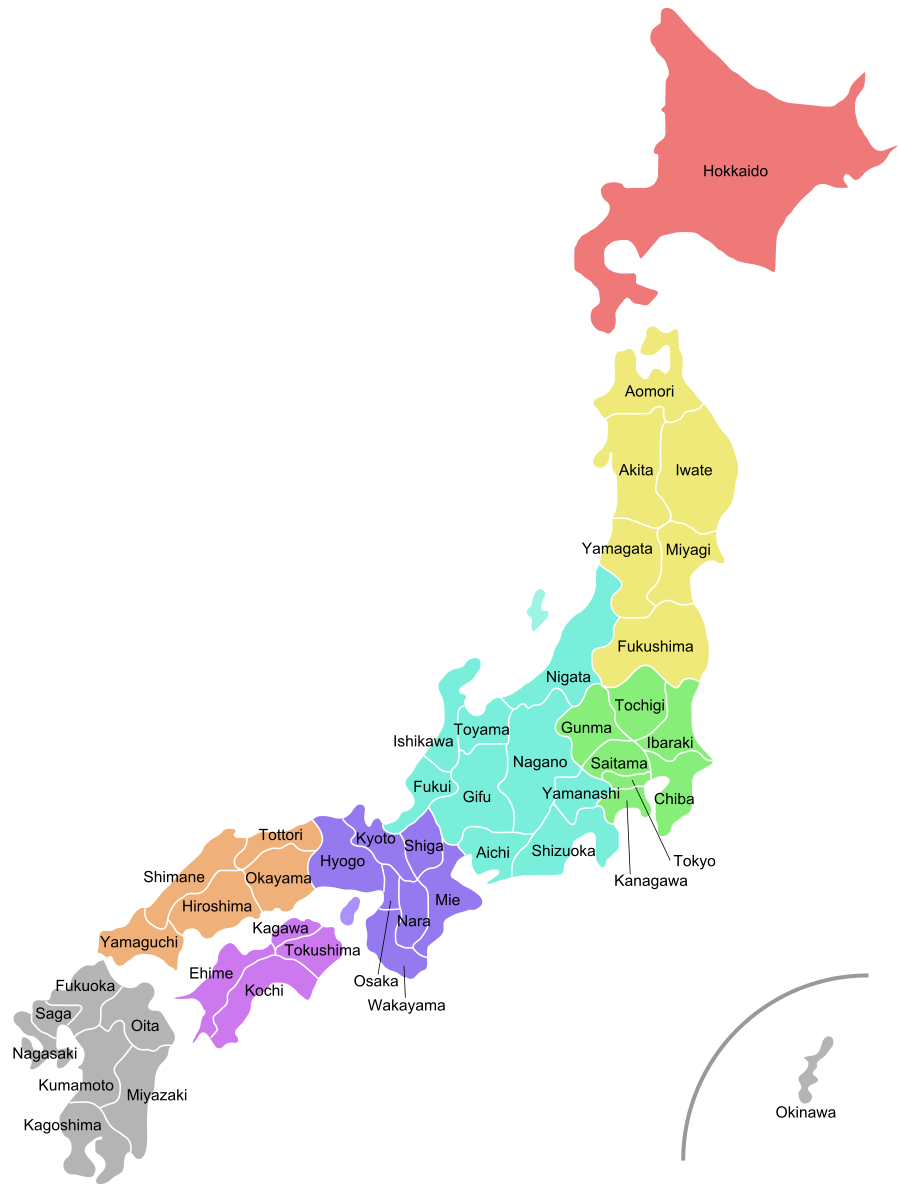
Where in the World?
Where in the world is Tokushima, Japan?
From the top of the map, the four main Japanese islands are:
Hokkiado (pink)
Honshu (multi-coloured)
Shikoku (violet)
Kyushu (grey)
On the eastern coast of the violet-coloured Shikoku is the prefecture of Tokushima. A prefecture is similar to a state in the U.S. We'll be living in the city of Tokushima which is the capital of the prefecture of Tokushima.
From Wikipedia.
From the top of the map, the four main Japanese islands are:
Hokkiado (pink)
Honshu (multi-coloured)
Shikoku (violet)
Kyushu (grey)
On the eastern coast of the violet-coloured Shikoku is the prefecture of Tokushima. A prefecture is similar to a state in the U.S. We'll be living in the city of Tokushima which is the capital of the prefecture of Tokushima.
From Wikipedia.
What Getting Married Means to Me, Part 2
Getting married means ... standing in line.
First at the Iowa DOT for a new license, then the passport agency, then for a new social security card.
Tuesday March 6: We arrived at the Federal Building at 12:40 for a 1:00 appointment to order a new passport for me to be able to travel with my new name. If being on time mattered, we would have been in trouble. We stood in the security metal detector line for 30 minutes before finally heading upstairs to face another line in the office. And a security guard who told David he wouldn’t be allowed in, since there was no room in the inn, so to speak. The place was, indeed, packed, but it meant David went downstairs to spend the bulk of his birthday waiting in the tiny canteen area.
I stood in line.
The line was fairly short, so I made it to the window in a short time, whereupon the clerk handed me a form to fill out and then bring back to her. Form duly filled out, I turned around and the line had grown by a factor of six. Other people at my stage of the game had jumped the queue and gone straight to the window. However there were now people in front of the passageway to the window - people waiting for others, and children and family members of people in line. The easiest way to the window was back in line.
Eighteen people later, I stood in front of the window again.
“Here’s your number. Have a seat and wait until it’s called.”
I sat. I waited.
The people ahead of me were being told to come back after 3:30 and pick up their passports. I listened to all kinds of wonderful travel stories, and about mission trips and a high school exchange student and many people who just received citizenship signing up for their U.S. passport for the first time.
Finally, though, it was my turn. I handed the clerk at Window 4 all of my documents and waited while she looked them over. “Did you come here from Iowa? Are you going back? When are you leaving Chicago?”
Those were a little funny, as they had nothing to do with my passport. I explained I was in Chicago just a couple days in order to get a new passport, then I would be on my way to Montana, flying to Japan from there.
She looked at the clock again. “The cutoff for today has passed. The earliest you could pick up your passport is tomorrow at 10:00.”
Not three people ahead of me had been able to pick up their new passports that day; I had just barely missed the deadline.
We were both exhausted by the time we got back to Vivian’s house. At least I remembered to buy an angel food cake, and we managed to sing Happy Birthday to David before he fell asleep.
First at the Iowa DOT for a new license, then the passport agency, then for a new social security card.
Tuesday March 6: We arrived at the Federal Building at 12:40 for a 1:00 appointment to order a new passport for me to be able to travel with my new name. If being on time mattered, we would have been in trouble. We stood in the security metal detector line for 30 minutes before finally heading upstairs to face another line in the office. And a security guard who told David he wouldn’t be allowed in, since there was no room in the inn, so to speak. The place was, indeed, packed, but it meant David went downstairs to spend the bulk of his birthday waiting in the tiny canteen area.
I stood in line.
The line was fairly short, so I made it to the window in a short time, whereupon the clerk handed me a form to fill out and then bring back to her. Form duly filled out, I turned around and the line had grown by a factor of six. Other people at my stage of the game had jumped the queue and gone straight to the window. However there were now people in front of the passageway to the window - people waiting for others, and children and family members of people in line. The easiest way to the window was back in line.
Eighteen people later, I stood in front of the window again.
“Here’s your number. Have a seat and wait until it’s called.”
I sat. I waited.
The people ahead of me were being told to come back after 3:30 and pick up their passports. I listened to all kinds of wonderful travel stories, and about mission trips and a high school exchange student and many people who just received citizenship signing up for their U.S. passport for the first time.
Finally, though, it was my turn. I handed the clerk at Window 4 all of my documents and waited while she looked them over. “Did you come here from Iowa? Are you going back? When are you leaving Chicago?”
Those were a little funny, as they had nothing to do with my passport. I explained I was in Chicago just a couple days in order to get a new passport, then I would be on my way to Montana, flying to Japan from there.
She looked at the clock again. “The cutoff for today has passed. The earliest you could pick up your passport is tomorrow at 10:00.”
Not three people ahead of me had been able to pick up their new passports that day; I had just barely missed the deadline.
We were both exhausted by the time we got back to Vivian’s house. At least I remembered to buy an angel food cake, and we managed to sing Happy Birthday to David before he fell asleep.
Saturday, March 03, 2012
The Work of Being Married
Getting married is more than getting a cool new last name. Now I have to remember all the places I have my name written down and change it in all those places. Not least of all, I have to remember to change it in my own head. It is a bit overwhelming, and I don’t even know where to begin.
No, that’s a lie. I guess I have an idea, because I went to the DMV in order to change the name on my drivers license today. I handed the clerk the requisite marriage certificate and old driver’s license.
Clerk: Have a seat and wait for your name to be called.
Me: Okay.
Clerk: Heather Green.
(Pause)
Me: Oh! Right!
Oops.
And that’s why we walked into the building in the first place. I can’t wait until we’re out and about and I begin ignoring people simply because I forget my own name.
No, that’s a lie. I guess I have an idea, because I went to the DMV in order to change the name on my drivers license today. I handed the clerk the requisite marriage certificate and old driver’s license.
Clerk: Have a seat and wait for your name to be called.
Me: Okay.
Clerk: Heather Green.
(Pause)
Me: Oh! Right!
Oops.
And that’s why we walked into the building in the first place. I can’t wait until we’re out and about and I begin ignoring people simply because I forget my own name.
Monday, February 27, 2012
Moving Again!
I never thought I’d be moving back to Japan. I remember saying, “I’m glad I went, but I don’t plan to live there forever.” Yet, David and I just bought one-way tickets to the Kansai International Airport (Hmmm, I hope I still have my Japanese-English dictionary!).
It’s been a long struggle to figure out where my future path lies. After a couple false starts, though, I’ve returned to EFL teaching, with a plan to continue and advance in this field. With this decision made, we leave for Japan on March 19.
I’ll be teaching English at an “English conversation school,” known as an Eikaiwa in Japanese, UI School of English. It is a small school run by a Japanese woman. We’ll be living on the island of Shikoku in the city of Tokushima.
The current plan is to stay at least a year (one-year contract, but possibility of renewal), and get a certification in EFL teaching, either concurrently or as a full-time course in a couple years.
Just like before, this blog is where I’ll post updates and links to Flickr where the photos are. Look for updates twice a month. Just because we’ll be in Japan doesn’t mean we’ll be far away. With Skype, email, and blogging, we’ll be as close as ever!
As we get closer to moving day, and as we settle in to our apartment in Tokushima, I’ll keep you all posted.
It’s been a long struggle to figure out where my future path lies. After a couple false starts, though, I’ve returned to EFL teaching, with a plan to continue and advance in this field. With this decision made, we leave for Japan on March 19.
I’ll be teaching English at an “English conversation school,” known as an Eikaiwa in Japanese, UI School of English. It is a small school run by a Japanese woman. We’ll be living on the island of Shikoku in the city of Tokushima.
The current plan is to stay at least a year (one-year contract, but possibility of renewal), and get a certification in EFL teaching, either concurrently or as a full-time course in a couple years.
Just like before, this blog is where I’ll post updates and links to Flickr where the photos are. Look for updates twice a month. Just because we’ll be in Japan doesn’t mean we’ll be far away. With Skype, email, and blogging, we’ll be as close as ever!
As we get closer to moving day, and as we settle in to our apartment in Tokushima, I’ll keep you all posted.
Monday, December 19, 2011
December 17, 2011: Fantasy Wish List:
A random assortment of the many things I want to do before I die.
Things I would like to learn how to make:
soap
candles
whisky
Foods I would like to eat:
Baked Alaska
Fugu
Travel related goals:
Make a Trans-Atlantic crossing by boat
Stay one night in a luxury hotel
Take a road trip along Route 66
Visit each of the seven continents (four down, three to go)
Ride in a helicopter
Other things I would like to do:
Get a Ph.D.
Write a travel memoir
Finish my novel
Name aforementioned novel --unfortunately Stranger in a Strange Land
is already the name of a sci-fi classic. I didn’t know that when I chose the name of my
(sci-fi) novel in progress.
Things I would like to learn how to make:
soap
candles
whisky
Foods I would like to eat:
Baked Alaska
Fugu
Travel related goals:
Make a Trans-Atlantic crossing by boat
Stay one night in a luxury hotel
Take a road trip along Route 66
Visit each of the seven continents (four down, three to go)
Ride in a helicopter
Other things I would like to do:
Get a Ph.D.
Write a travel memoir
Finish my novel
Name aforementioned novel --unfortunately Stranger in a Strange Land
is already the name of a sci-fi classic. I didn’t know that when I chose the name of my
(sci-fi) novel in progress.
Friday, December 16, 2011
December 15: Dinner Help
Chicken teriyaki fried rice is an easy, easy dish to make. Put rice, frozen veggies, and chicken into a pot. Season with teriyaki sauce. Stir. Heat until hot. Eat. Easy Peasy. So, when Hannah asked to help, I was at a loss. “Um, sure -- I’ll go sit down. You can make dinner.” What on earth could I have her do?
Let me sum up: Hannah. Kindergarten. Picture a pin-ball machine played by someone who really knows how to keep that ball moving. Now imaging that person playing with ten balls. Now put all those balls inside Hannah and watch her bounce.
Ah-ha! Pinball! Hannah, please bring me some frozen vegetables. Find a large spoon. Find a small spoon. Find a utensil that is not a spoon. Get a bowl and two eggs. It worked perfectly. Around the room. Back and forth. Up and down.
Then I ran out of things I needed her to bring to me.
But, pouring vegetables into a bowl is not so messy. Oh, no there goes the corn! (Just kidding. She did very well). “I like cracking eggs!” With much trepidation and a great deal of looking the other way, I let her crack eggs into a bowl. Whew. That went much better than I imagined.
“Please throw away the eggshells.”
“Okay.” But not before crumbing them into little pieces into the trash can.
I wanted to get after her, but she did so well up until now not messing around. We did, however, have a discussion on the importance of washing her hands after handling raw eggs. Or rubbing raw egg all over her hands like lotion. Or whatever.
She helped pour and scrape and stir. She only once fell off the step ladder with a heart-stopping crash. She was fine. I, on the other hand, had to be brought back with electric shock.
Then it was time to add the rice. I had cooked the rice earlier in a crock pot, as my rice cooker is in storage at the moment. When it was time to transfer the rice into the pot of chicken and veggies, I asked Hannah to go find a spoon. “The biggest one you can find.”
She looked in the drawer and picked up the small wooden spoon laying next to the gigantic ladle. “How about this?”
“How about something bigger?”
“Is this a spoon?”
“It’s a melon baller.”
“Oh.” Then she looked at the ladle, which I had thought looks like a big spoon, and discarded it for a different wooden spoon. A different wooden spoon which happened to be resting on top of a giant black plastic serving spoon. “This one? I want to use a wood spoon.”
I happen to love wooden spoons, and had I a bamboo rice scoop, it would have been what I sent her after. As it is, we were short a rice scoop of any material, let alone wood.
It took several tries, but we finally agreed on the ladle. And then the fun began. I had her grab the bigger utensil because I knew anything smaller would result in massive amounts of sticky rice falling all over the floor. With the ladle, we had small amounts of sticky rice falling all over the floor. My rules for myself were such that I promised myself I would not help her unless she was in danger, the dinner was in danger, or she asked for help. A little rice on the floor did not fall into these categories.
It did, though, fall into the category of “Ewww, I just stepped in something cold, squishy, and sticky. I guess it’s a good thing I am wearing socks.”
And sticky it was. Hannah frequently had rice stuck to her fingers as she worked. “I got rice on my finger. Can I eat it?”
“Oh, no. I have rice on my fingers again. Can I eat it?”
“Six cups of rice seem to have fallen into my hand, can I eat it?”
We finally got it all together, and stirred. Five year old energy was successfully harnessed into a rice and vegetables. She was so proud. It was a fun night, really. The other kids all ate seconds, and but for the rice, nothing major was spilled.
Now, though, if you will excuse me, I have to change my socks.
Let me sum up: Hannah. Kindergarten. Picture a pin-ball machine played by someone who really knows how to keep that ball moving. Now imaging that person playing with ten balls. Now put all those balls inside Hannah and watch her bounce.
Ah-ha! Pinball! Hannah, please bring me some frozen vegetables. Find a large spoon. Find a small spoon. Find a utensil that is not a spoon. Get a bowl and two eggs. It worked perfectly. Around the room. Back and forth. Up and down.
Then I ran out of things I needed her to bring to me.
But, pouring vegetables into a bowl is not so messy. Oh, no there goes the corn! (Just kidding. She did very well). “I like cracking eggs!” With much trepidation and a great deal of looking the other way, I let her crack eggs into a bowl. Whew. That went much better than I imagined.
“Please throw away the eggshells.”
“Okay.” But not before crumbing them into little pieces into the trash can.
I wanted to get after her, but she did so well up until now not messing around. We did, however, have a discussion on the importance of washing her hands after handling raw eggs. Or rubbing raw egg all over her hands like lotion. Or whatever.
She helped pour and scrape and stir. She only once fell off the step ladder with a heart-stopping crash. She was fine. I, on the other hand, had to be brought back with electric shock.
Then it was time to add the rice. I had cooked the rice earlier in a crock pot, as my rice cooker is in storage at the moment. When it was time to transfer the rice into the pot of chicken and veggies, I asked Hannah to go find a spoon. “The biggest one you can find.”
She looked in the drawer and picked up the small wooden spoon laying next to the gigantic ladle. “How about this?”
“How about something bigger?”
“Is this a spoon?”
“It’s a melon baller.”
“Oh.” Then she looked at the ladle, which I had thought looks like a big spoon, and discarded it for a different wooden spoon. A different wooden spoon which happened to be resting on top of a giant black plastic serving spoon. “This one? I want to use a wood spoon.”
I happen to love wooden spoons, and had I a bamboo rice scoop, it would have been what I sent her after. As it is, we were short a rice scoop of any material, let alone wood.
It took several tries, but we finally agreed on the ladle. And then the fun began. I had her grab the bigger utensil because I knew anything smaller would result in massive amounts of sticky rice falling all over the floor. With the ladle, we had small amounts of sticky rice falling all over the floor. My rules for myself were such that I promised myself I would not help her unless she was in danger, the dinner was in danger, or she asked for help. A little rice on the floor did not fall into these categories.
It did, though, fall into the category of “Ewww, I just stepped in something cold, squishy, and sticky. I guess it’s a good thing I am wearing socks.”
And sticky it was. Hannah frequently had rice stuck to her fingers as she worked. “I got rice on my finger. Can I eat it?”
“Oh, no. I have rice on my fingers again. Can I eat it?”
“Six cups of rice seem to have fallen into my hand, can I eat it?”
We finally got it all together, and stirred. Five year old energy was successfully harnessed into a rice and vegetables. She was so proud. It was a fun night, really. The other kids all ate seconds, and but for the rice, nothing major was spilled.
Now, though, if you will excuse me, I have to change my socks.
Wednesday, December 07, 2011
A New Mission
Yesterday marked three weeks since we arrived back in the midwest. Until we know what is next, our base is our friends’ basement in small town Illinois. It’s a great arrangement: they let us stay and eat, while we watch their kids and cook. This is not a new arrangement for me; I have done this in Waverly, Lake Mills, and ... well, maybe that’s it. But the arrangement is temporary, so I am job hunting.
I have applied for every job for which I might possibly qualify, although that does not yet include fast food and telemarketing because I don’t know if I’m even qualified for those. However, I landed a summer job teaching Intro to World Religions at a local community college. Of course, I am still looking for something to fill the void before - and after - that interlude in my unemployment.
I thought I would be finished writing my blog when we got back home from Scotland, but then I decided to keep it up. This is going to be a new challenge for me: keeping a blog when I am not out travelling. Adventures in Mission? How about finding adventure in everyday life? The new mission.
I have applied for every job for which I might possibly qualify, although that does not yet include fast food and telemarketing because I don’t know if I’m even qualified for those. However, I landed a summer job teaching Intro to World Religions at a local community college. Of course, I am still looking for something to fill the void before - and after - that interlude in my unemployment.
I thought I would be finished writing my blog when we got back home from Scotland, but then I decided to keep it up. This is going to be a new challenge for me: keeping a blog when I am not out travelling. Adventures in Mission? How about finding adventure in everyday life? The new mission.
Sunday, November 13, 2011
November 12, 2011: Moving Day
Today is moving day. One more time! Okay ... two more times, but this is our last move within England. The apartment we booked for our time in London was only available until Nov 12. Our flight is Nov 14.
For the last two days we are booked into a hotel right underneath the landing planes of Heathrow. It will be impossible to sleep, I’m sure. However, I would rather make the arduous journey to the airport today when I am not worried about missing my flight, than on Monday morning. This is a trial run for getting ready to fly.
We’ve been here two weeks, so the suitcases are well and truly exploded all over. From Saturday night to Sunday morning, I do not imagine we will have the same amount of packing to do.
Crystal Palace is a delightful place. It is a quiet place to live, albeit still a busy, close-to-inner-London suburb. The area was named for a Victorian-era exhibition hall, which delighted people until a fire took its toll in the 1930s. Much of the town is still Victorian in its architecture, although modern buildings are found here and there.
It has been pleasant to stay here. The park was a beautiful place to spend a few hours in the afternoon. There is a hedge maze, though at this time of year it is truly a sad sight to behold. If it weren’t for the chicken wire fences in between the rows, the empty bushes would just look like winter is coming. With the fences holding people in their rows, and the leaves fallen off the bushes, the effect is more one of decrepitude, rather than natural order.
The park also contains several dinosaur statues. Although life-size and designed by a scholar of natural history, today palaeontologists claim they are inaccurate, due to new research. I still think they are cool.
I’ll miss the park, and being able to get the best Indian food in London (in my humble opinion ; ) ). I won’t miss hiking up the hill to the highest point in all of greater London every night at the end of sightseeing, just to have to walk up three fights of stairs to get to our attic apartment.
In Orkney, Inverness, and in London, how did we always manage to find accommodations at the top of steep inclines? Well, I guess it keeps the heart pumping.
London’s Underground is undergoing massive construction work this month. Every possible line leaving Crystal Palace, and the only line to the airport are all being replaced by buses for portions of their journeys. The thought of dragging the suitcases up and down stairs to the trains, changing to a bus, back to a train, then a different train to a bus, then back to the train...umm, No thank you. Instead, we’ll take two buses. That’s all. It should take at least a couple hours to get across the city, but it will be easy.
We’ll have one more day out in London tomorrow. One more chance for blogging!
For the last two days we are booked into a hotel right underneath the landing planes of Heathrow. It will be impossible to sleep, I’m sure. However, I would rather make the arduous journey to the airport today when I am not worried about missing my flight, than on Monday morning. This is a trial run for getting ready to fly.
We’ve been here two weeks, so the suitcases are well and truly exploded all over. From Saturday night to Sunday morning, I do not imagine we will have the same amount of packing to do.
Crystal Palace is a delightful place. It is a quiet place to live, albeit still a busy, close-to-inner-London suburb. The area was named for a Victorian-era exhibition hall, which delighted people until a fire took its toll in the 1930s. Much of the town is still Victorian in its architecture, although modern buildings are found here and there.
It has been pleasant to stay here. The park was a beautiful place to spend a few hours in the afternoon. There is a hedge maze, though at this time of year it is truly a sad sight to behold. If it weren’t for the chicken wire fences in between the rows, the empty bushes would just look like winter is coming. With the fences holding people in their rows, and the leaves fallen off the bushes, the effect is more one of decrepitude, rather than natural order.
The park also contains several dinosaur statues. Although life-size and designed by a scholar of natural history, today palaeontologists claim they are inaccurate, due to new research. I still think they are cool.
I’ll miss the park, and being able to get the best Indian food in London (in my humble opinion ; ) ). I won’t miss hiking up the hill to the highest point in all of greater London every night at the end of sightseeing, just to have to walk up three fights of stairs to get to our attic apartment.
In Orkney, Inverness, and in London, how did we always manage to find accommodations at the top of steep inclines? Well, I guess it keeps the heart pumping.
London’s Underground is undergoing massive construction work this month. Every possible line leaving Crystal Palace, and the only line to the airport are all being replaced by buses for portions of their journeys. The thought of dragging the suitcases up and down stairs to the trains, changing to a bus, back to a train, then a different train to a bus, then back to the train...umm, No thank you. Instead, we’ll take two buses. That’s all. It should take at least a couple hours to get across the city, but it will be easy.
We’ll have one more day out in London tomorrow. One more chance for blogging!
Friday, November 11, 2011
November 7: Harrods
I have mixed feeling about Harrods. On one hand it is a London icon. It has been a department store in London since 1824. Its history is interesting, being the first store in London to install a “moving staircase”in 1898. It has served the likes of A.A. Milne, Oscar Wilde, Noel Coward, Charlie Chaplin, and various members of the royal family.
It sells a little of everything. Okay, it sells a lot of everything. I started in the food area and skipped most of the clothing: slacks, dresses, purses, shoes, custom made suits. You can buy books, fountain pens, stationery, air hockey tables, gold (I mean gold, not jewelery, although they sell that, too), and by appointment only, bullet-proof clothing.
I had been looking forward to wandering through the racks of Kevlar vests hanging on the racks next to the Hermes scarves, but apparently that isn’t how the department works. Besides, the Hermes department was four floors down from Bullet Proof Clothing.
The clothing and accessories are famous names. Even I have heard of some of the names. But really, fashionable shopping is wasted on me. I love the idea of looking elegant, but I love my flannel shirts and jeans too much to do anything about it.
So there I was, wandering through the most famous department store in the western hemisphere, wondering if I would get kicked out for violating the dress code. Jeans, scuffed-up muddy Eastlands, and a Goodwill purchased shirt boasting a Cabella’s label. Other than being ignored at the food sample stands, though, no one seemed to care how I was dressed. While I drooled over the $4000 fountain pens, I actually had two sales associated ask if I needed help. Maybe they were just concerned I was in the wrong store and were willing to give me directions to the nearest Asda. “You know, there’s an Ikea just down the street,” they were thinking.
While having this fascination with seeing the famous London department store, and wondering how the upper echelon lives, I hate paying for a name. I have an aversion to paying grandiose amounts of money for anything, unless the quality is such that the price covers the long years of use I will get out if it,. My favourite purse, for example. I used it for almost ten years. Of course, I spent almost $100 on it. I about died handing over that much money for a purse. But I used it for years and years.
And there I was in Harrods staring at purses costing 10 times that.
I do not understand fashion, and I confuse it with quality. Are the goods in Harrods worth their price? Or even, taking into consideration a typical 30% mark-up, are they worth two thirds of their price?
Are customers paying for a name? It is a famous name. Are customers paying for quality? Famous does not necessarily mean quality. But, sometimes it does. I guess I’ll never know until I try.
Harrods. I went. I saw. I bought.
It sells a little of everything. Okay, it sells a lot of everything. I started in the food area and skipped most of the clothing: slacks, dresses, purses, shoes, custom made suits. You can buy books, fountain pens, stationery, air hockey tables, gold (I mean gold, not jewelery, although they sell that, too), and by appointment only, bullet-proof clothing.
I had been looking forward to wandering through the racks of Kevlar vests hanging on the racks next to the Hermes scarves, but apparently that isn’t how the department works. Besides, the Hermes department was four floors down from Bullet Proof Clothing.
The clothing and accessories are famous names. Even I have heard of some of the names. But really, fashionable shopping is wasted on me. I love the idea of looking elegant, but I love my flannel shirts and jeans too much to do anything about it.
So there I was, wandering through the most famous department store in the western hemisphere, wondering if I would get kicked out for violating the dress code. Jeans, scuffed-up muddy Eastlands, and a Goodwill purchased shirt boasting a Cabella’s label. Other than being ignored at the food sample stands, though, no one seemed to care how I was dressed. While I drooled over the $4000 fountain pens, I actually had two sales associated ask if I needed help. Maybe they were just concerned I was in the wrong store and were willing to give me directions to the nearest Asda. “You know, there’s an Ikea just down the street,” they were thinking.
While having this fascination with seeing the famous London department store, and wondering how the upper echelon lives, I hate paying for a name. I have an aversion to paying grandiose amounts of money for anything, unless the quality is such that the price covers the long years of use I will get out if it,. My favourite purse, for example. I used it for almost ten years. Of course, I spent almost $100 on it. I about died handing over that much money for a purse. But I used it for years and years.
And there I was in Harrods staring at purses costing 10 times that.
I do not understand fashion, and I confuse it with quality. Are the goods in Harrods worth their price? Or even, taking into consideration a typical 30% mark-up, are they worth two thirds of their price?
Are customers paying for a name? It is a famous name. Are customers paying for quality? Famous does not necessarily mean quality. But, sometimes it does. I guess I’ll never know until I try.
Harrods. I went. I saw. I bought.
Thursday, November 10, 2011
November 8: Stonehenge and Bath
Part 2: Stonehenge
Rising up out of the tunnel into the field, the first thing I notice is their size. Stonehenge is huge. Enormous. I am used to seeing them on television; in books. Size is deceptive.
The second thing I noticed is how amazed I am by their size. I had just been there two years before. I should not have been this awe-struck. But that is Stonehenge. It does not become less impressive by familiarity. It just gains in mystery and grandeur. The more I study it and learn about it, the more magnificent it becomes.
New studies of the area are always being undertaken. New theories tested. New evidence being found. Nearby at Durrington Walls is the site of a settlement. Archaeologists believe it might be the settlement of workers who built Stonehenge. Who were they, and why here?
Within the last few years, evidence of another stone circle has been found nearby. Research points to the existence of another circle at the end of the ancient avenue leading out from Stonehenge to the river Avon. Are they related? Were they two parts of one ritualistic journey?
The stones at Stonehenge come from two places: The smaller inner circle of stones are from nearby fields, no more than twenty miles way, The larger stones are from Wales.150 miles away. Why not just build the circle in Wales?
I drug David to every possible stone circle in bussing distance all over Scotland. All equally impressive and equally mysterious. Yet, none like Stonehenge. I haven’t done my research yet, but our guide yesterday told us it is unique in Britain because it is the only one that used sculpted stones. The other circles were made of natural stone, but stonemasons shaped Stonehenge’s boulders into the uniform monoliths we see today.
While research is carried out all over the surrounding area, Stonehenge itself is rarely a dig site. Although I do not know for certain why that is, I do have my guesses. Archaeology, while being beneficial to our knowledge of the past, is invasive surgery. In order to get under the ground, we have to dig up the present. There are ways of minimising damage, such as using radar to search for clues underground before digging pell-mell. It does not seem difficult to dig in small sections, and carefully replace dirt to put things back to normal.
However, a clue from a Smithsonian article in 2009 provides insight into views on Stonehenge. Before beginning the first dig on the Stonehenge in 44 years, prayers were spoken and blessings were requested. Even today, Stonehenge is still a holy place. Druids worship here at the Solstices. The mounds surrounding the area are the burial places of hundreds of people.
Yet, we do much research and digging across the middle east and the cradle of Christianity, Judaism and Islam. We want to know our history, including our religious history.
That leaves me to agree with Geoffrey Wainright, President of the Society of Antiquaries of London. He was involved in the research at Stonehenge in 2009. He told Smithsonian,“I think what most people like about Stonehenge is that nobody really knows why it was built, and I think that’s probably always going to be the case. It’s a bloody great mystery.”
http://www.smithsonianmag.com/history-archaeology/light-on-stonehenge.html#ixzz1dHkr1ACk
Rising up out of the tunnel into the field, the first thing I notice is their size. Stonehenge is huge. Enormous. I am used to seeing them on television; in books. Size is deceptive.
The second thing I noticed is how amazed I am by their size. I had just been there two years before. I should not have been this awe-struck. But that is Stonehenge. It does not become less impressive by familiarity. It just gains in mystery and grandeur. The more I study it and learn about it, the more magnificent it becomes.
New studies of the area are always being undertaken. New theories tested. New evidence being found. Nearby at Durrington Walls is the site of a settlement. Archaeologists believe it might be the settlement of workers who built Stonehenge. Who were they, and why here?
Within the last few years, evidence of another stone circle has been found nearby. Research points to the existence of another circle at the end of the ancient avenue leading out from Stonehenge to the river Avon. Are they related? Were they two parts of one ritualistic journey?
The stones at Stonehenge come from two places: The smaller inner circle of stones are from nearby fields, no more than twenty miles way, The larger stones are from Wales.150 miles away. Why not just build the circle in Wales?
I drug David to every possible stone circle in bussing distance all over Scotland. All equally impressive and equally mysterious. Yet, none like Stonehenge. I haven’t done my research yet, but our guide yesterday told us it is unique in Britain because it is the only one that used sculpted stones. The other circles were made of natural stone, but stonemasons shaped Stonehenge’s boulders into the uniform monoliths we see today.
While research is carried out all over the surrounding area, Stonehenge itself is rarely a dig site. Although I do not know for certain why that is, I do have my guesses. Archaeology, while being beneficial to our knowledge of the past, is invasive surgery. In order to get under the ground, we have to dig up the present. There are ways of minimising damage, such as using radar to search for clues underground before digging pell-mell. It does not seem difficult to dig in small sections, and carefully replace dirt to put things back to normal.
However, a clue from a Smithsonian article in 2009 provides insight into views on Stonehenge. Before beginning the first dig on the Stonehenge in 44 years, prayers were spoken and blessings were requested. Even today, Stonehenge is still a holy place. Druids worship here at the Solstices. The mounds surrounding the area are the burial places of hundreds of people.
Yet, we do much research and digging across the middle east and the cradle of Christianity, Judaism and Islam. We want to know our history, including our religious history.
That leaves me to agree with Geoffrey Wainright, President of the Society of Antiquaries of London. He was involved in the research at Stonehenge in 2009. He told Smithsonian,“I think what most people like about Stonehenge is that nobody really knows why it was built, and I think that’s probably always going to be the case. It’s a bloody great mystery.”
http://www.smithsonianmag.com/history-archaeology/light-on-stonehenge.html#ixzz1dHkr1ACk
Wednesday, November 09, 2011
November 8: Stonehenge and Bath
Part 1: Bath
On Tuesday David and I joined a day trip tour to Stonehenge and Bath. My two favourite historical periods: Neo-lithic and Roman Empire, although, both Stonehenge and Bath had histories longer than I thought, Stonehenge stretching to Bronze Age, and Bath’s turn-about in Victorian times.
The pool, the actual Bath in Bath, is quite impressive. I know the water isn’t supposed to be green; that it only is green because of algae and the fact that the pool is not treated for human use. But it looks like tarnished copper. Magnificent, yet hiding its glory. Old, but recognisable.
Because we were on a day tour, I knew we would only have a couple hours in the town of Bath. I did not know the tour of the actual Baths would take me the whole two hours. I wandered the through the displays without being able to fully enjoy them due to our being chronologically limited. In spite of time constraints, I lingered over the audio tour. One of my favourite authors and hero of travelling, Bill Bryson, has been given the honour of providing commentary for parts of the audio tour. I used up much of my time listening to him!
I walked quickly past gravestones, past coins, past lead pipes (the Romans loved their lead), past stone-carving demonstrations and over the courtyard of what was once a grand temple. Apparently only two temples have been found in Britain, this one for the goddess Minerva. The temple was dedicated to Sulis-Minerva, the hybrid of the celtic goddess Sulis, already being worshipped at the site before the Romans came in.
Any good conqueror knows the way to assimilate people is to convince them to keep doing what they had been doing before the conqueror showed up: “Hmm, you worship Sulis in these relaxing and healing waters? Okay, we’ll do that, too. This Sulis sounds just like our goddess Minerva. They must be the same goddess, don’t you think? We’ll re-dedicate the temple to Sulis Minerva.” And life continues as normal.
Bath the city is not at all what I expected. Built between seven hills, I did not expect the city to have grown so large as to be built on, over, and around the seven hills. The hills are lined up and down with Georgian townhouses. Ringing the tops of the hills are the luxurious Crescents, houses for wealthy residents to have sweeping views of the valleys.
Bath was in Roman times and in Victorian times and is again now, a resort town. For many years it was not. Bath housed woollen mills and factories, driving away respectable residents and in the end giving the town a bad name, one known for carousing, drunkenness, and crime. It is hard to imagine that, today, given all the glitz and sparkle in the city now saturating the city. Boutiques and movie stars and royal residents and spa treatments all shine in today’s Bath.
We drove past 4 Sydney Road, Jane Austin’s former residence. 8 Circus Crescent, Nicholas Cage’s former residence. Rumour has it Johnny Depp recently bought property in the town, but I didn’t see a gaggle of women with cameras lingering outside anyone’s door, so I assume we didn’t pass it.
Nobles and Stars. Millionaires and the merely wealthy. They live among the blue-jeaned tourists who come for the day. On the other hand, someone has to work in the shops and coffee houses. People have to clean the mess tourists and rich people leave behind. I wonder where they live? Someone asked our driver about how people make a living in the town, and he said it’s all connected to tourism. But tourism doesn’t usually pay individuals well enough to live in a resort.
We only saw one side of Bath, but we were not there long enough to discover if there was a “wrong side of the tracks.” The train connects the town to others on the way back to London. Perhaps they live in other towns and commute in. I wonder if I had time, would we have found where the normal people live? Or is it so well hidden that we never would?
On Tuesday David and I joined a day trip tour to Stonehenge and Bath. My two favourite historical periods: Neo-lithic and Roman Empire, although, both Stonehenge and Bath had histories longer than I thought, Stonehenge stretching to Bronze Age, and Bath’s turn-about in Victorian times.
The pool, the actual Bath in Bath, is quite impressive. I know the water isn’t supposed to be green; that it only is green because of algae and the fact that the pool is not treated for human use. But it looks like tarnished copper. Magnificent, yet hiding its glory. Old, but recognisable.
Because we were on a day tour, I knew we would only have a couple hours in the town of Bath. I did not know the tour of the actual Baths would take me the whole two hours. I wandered the through the displays without being able to fully enjoy them due to our being chronologically limited. In spite of time constraints, I lingered over the audio tour. One of my favourite authors and hero of travelling, Bill Bryson, has been given the honour of providing commentary for parts of the audio tour. I used up much of my time listening to him!
I walked quickly past gravestones, past coins, past lead pipes (the Romans loved their lead), past stone-carving demonstrations and over the courtyard of what was once a grand temple. Apparently only two temples have been found in Britain, this one for the goddess Minerva. The temple was dedicated to Sulis-Minerva, the hybrid of the celtic goddess Sulis, already being worshipped at the site before the Romans came in.
Any good conqueror knows the way to assimilate people is to convince them to keep doing what they had been doing before the conqueror showed up: “Hmm, you worship Sulis in these relaxing and healing waters? Okay, we’ll do that, too. This Sulis sounds just like our goddess Minerva. They must be the same goddess, don’t you think? We’ll re-dedicate the temple to Sulis Minerva.” And life continues as normal.
Bath the city is not at all what I expected. Built between seven hills, I did not expect the city to have grown so large as to be built on, over, and around the seven hills. The hills are lined up and down with Georgian townhouses. Ringing the tops of the hills are the luxurious Crescents, houses for wealthy residents to have sweeping views of the valleys.
Bath was in Roman times and in Victorian times and is again now, a resort town. For many years it was not. Bath housed woollen mills and factories, driving away respectable residents and in the end giving the town a bad name, one known for carousing, drunkenness, and crime. It is hard to imagine that, today, given all the glitz and sparkle in the city now saturating the city. Boutiques and movie stars and royal residents and spa treatments all shine in today’s Bath.
We drove past 4 Sydney Road, Jane Austin’s former residence. 8 Circus Crescent, Nicholas Cage’s former residence. Rumour has it Johnny Depp recently bought property in the town, but I didn’t see a gaggle of women with cameras lingering outside anyone’s door, so I assume we didn’t pass it.
Nobles and Stars. Millionaires and the merely wealthy. They live among the blue-jeaned tourists who come for the day. On the other hand, someone has to work in the shops and coffee houses. People have to clean the mess tourists and rich people leave behind. I wonder where they live? Someone asked our driver about how people make a living in the town, and he said it’s all connected to tourism. But tourism doesn’t usually pay individuals well enough to live in a resort.
We only saw one side of Bath, but we were not there long enough to discover if there was a “wrong side of the tracks.” The train connects the town to others on the way back to London. Perhaps they live in other towns and commute in. I wonder if I had time, would we have found where the normal people live? Or is it so well hidden that we never would?
November 5, 2011 : Westminster Abbey
Every tour book, advice guide, and review blog warns tourists to arrive early and even so, be prepared for a very long wait to enter Westminster Abbey. Some reviewers claimed to stand in line for an hour, or not quite, because they left before they were allowed inside.
David and I ended up at the Abbey just out sheer necessity. We had several hours until Wicked began, and an afternoon with nothing else planned. We were ready for an hour staring at the old stone walls.
However, 12:30 on a Friday afternoon in November is apparently not a busy time at the venerable church. The line to enter the building was approximately three people long. The audio guide kindly tells people to “keep walking” through narrow points and bottleneck passages, but I found I could linger as long as I wanted around the tombs of Queen Elizabeth I, Mary Queen of Scots, and St Edward the Confessor. Except St. Edward the Confessor’s tomb is on a dais behind King Henry III and a couple other medieval kings. I just had to stare at the tombs in a circular shape, and know the top of the platform was built for the saintly king seven centuries ago.
I love to visit cemeteries and read gravestones, but I try to avoid walking across the graves. It feels disrespectful to me. Yet, here in the abbey, every floor stone is lined with writing. Under the floors are vaults where the former inhabitants and a few national heroes are put for their final resting place. It is impossible to walk through it without walking over graves. I soon did get over the feeling of disrespect because there was so much to read!
I am glad the crowds were manageable, because then I could stop to inspect the stones. Every nook, every inch of floor, and most walls, are filled with tombstones, memorials, markers, commemorations. Charles Darwin, whose plain tombstone simply lists his name and dates, lies a few feet from Ralph Vaughn Williams, whose smaller and newer stone also lists only his name and dates. It was fun to go through and see who I recognised.
Dukes, duchesses,non-monarchs of the royal family. All the names who once would have been well-known now are written in Latin in forgotten alcoves skipped over on the audio tour. But at least when I stumbled in them by accident, I knew they were important people at one time. They have elaborate marble tombs and memorials; statues and likenesses. Gilt or painted decorations.
The floor is also covered with stones, many worn smooth from hundreds of years of monks, worshippers, and tourists. Abbots, organist and choirmasters, headmasters of the school choir, the monks themselves, and even people who worked for the Abbey in any way, were all buried here. Their stones line the cloister and the halls.
600 years ago, a poet and royal bureaucrat rented rooms in the Abbey. When he died, as was customary for their tenants, he was buried in the Abbey. As it turns out this was not just any poet, but Geoffrey Chaucer. Instead of becoming a forgotten book-keeper, he became the first person buried in Poet’s Corner, and immortalised by his Canterbury Tales. Poet’s corner was expanded to included other artists. Now Rudyard Kipling, George Frederick Handel and Laurence Olivier, among others, rest near the former scribe.
In one alcove is a memorial to James Watt, not buried in the Abbey, but commemorated by a “grateful king for his work on the steam engine.” I had recently been studying his steam engines in museums in Scotland, and visiting what remains of his house near Edinburgh, so I was pretty excited to recognise his name.
The grandest tomb in the Abbey does not belong to a king, although George III tried; nor to a queen, although Elisabeth I also tried. One marble carving of an old man holding a scroll, sitting next to a globe, and surrounded by cherubs and clouds is large. Very large. And sits in the middle of the nave, on the right hand of the altar used for daily prayer services. The base of the statue is a foot tall, trying to get in all the important reasons why this man is buried in the Abbey. The tomb marks the grave of no less an imposing figure than Isaac Newton. The weighty tomb does seem fitting for a man who taught the world why the statues will not move unless presented with sufficient force.
Yet, with all the famous people, I found myself drawn to the simple stones. The ones who are not on the audio tour. Faithful worshippers, canons, the names who no longer hold meaning for us. Who were they? Do they still have family come to visit their graves? There are newer graves, of course. I saw a few from the 1980s and 1990s, but what about the stones whose 17th century death date can only just be read? Are they forgotten? In the hubbub to see the grandest tomb in the Abbey, their names and epithets are worn off by millions of feet.
David and I ended up at the Abbey just out sheer necessity. We had several hours until Wicked began, and an afternoon with nothing else planned. We were ready for an hour staring at the old stone walls.
However, 12:30 on a Friday afternoon in November is apparently not a busy time at the venerable church. The line to enter the building was approximately three people long. The audio guide kindly tells people to “keep walking” through narrow points and bottleneck passages, but I found I could linger as long as I wanted around the tombs of Queen Elizabeth I, Mary Queen of Scots, and St Edward the Confessor. Except St. Edward the Confessor’s tomb is on a dais behind King Henry III and a couple other medieval kings. I just had to stare at the tombs in a circular shape, and know the top of the platform was built for the saintly king seven centuries ago.
I love to visit cemeteries and read gravestones, but I try to avoid walking across the graves. It feels disrespectful to me. Yet, here in the abbey, every floor stone is lined with writing. Under the floors are vaults where the former inhabitants and a few national heroes are put for their final resting place. It is impossible to walk through it without walking over graves. I soon did get over the feeling of disrespect because there was so much to read!
I am glad the crowds were manageable, because then I could stop to inspect the stones. Every nook, every inch of floor, and most walls, are filled with tombstones, memorials, markers, commemorations. Charles Darwin, whose plain tombstone simply lists his name and dates, lies a few feet from Ralph Vaughn Williams, whose smaller and newer stone also lists only his name and dates. It was fun to go through and see who I recognised.
Dukes, duchesses,non-monarchs of the royal family. All the names who once would have been well-known now are written in Latin in forgotten alcoves skipped over on the audio tour. But at least when I stumbled in them by accident, I knew they were important people at one time. They have elaborate marble tombs and memorials; statues and likenesses. Gilt or painted decorations.
The floor is also covered with stones, many worn smooth from hundreds of years of monks, worshippers, and tourists. Abbots, organist and choirmasters, headmasters of the school choir, the monks themselves, and even people who worked for the Abbey in any way, were all buried here. Their stones line the cloister and the halls.
600 years ago, a poet and royal bureaucrat rented rooms in the Abbey. When he died, as was customary for their tenants, he was buried in the Abbey. As it turns out this was not just any poet, but Geoffrey Chaucer. Instead of becoming a forgotten book-keeper, he became the first person buried in Poet’s Corner, and immortalised by his Canterbury Tales. Poet’s corner was expanded to included other artists. Now Rudyard Kipling, George Frederick Handel and Laurence Olivier, among others, rest near the former scribe.
In one alcove is a memorial to James Watt, not buried in the Abbey, but commemorated by a “grateful king for his work on the steam engine.” I had recently been studying his steam engines in museums in Scotland, and visiting what remains of his house near Edinburgh, so I was pretty excited to recognise his name.
The grandest tomb in the Abbey does not belong to a king, although George III tried; nor to a queen, although Elisabeth I also tried. One marble carving of an old man holding a scroll, sitting next to a globe, and surrounded by cherubs and clouds is large. Very large. And sits in the middle of the nave, on the right hand of the altar used for daily prayer services. The base of the statue is a foot tall, trying to get in all the important reasons why this man is buried in the Abbey. The tomb marks the grave of no less an imposing figure than Isaac Newton. The weighty tomb does seem fitting for a man who taught the world why the statues will not move unless presented with sufficient force.
Yet, with all the famous people, I found myself drawn to the simple stones. The ones who are not on the audio tour. Faithful worshippers, canons, the names who no longer hold meaning for us. Who were they? Do they still have family come to visit their graves? There are newer graves, of course. I saw a few from the 1980s and 1990s, but what about the stones whose 17th century death date can only just be read? Are they forgotten? In the hubbub to see the grandest tomb in the Abbey, their names and epithets are worn off by millions of feet.
Tuesday, November 08, 2011
November 4: Being a Tourist
We walked from Piccadilly Square to Wesminster Abbey, passing theatres lit with their show advertisements. I longed to take in Phantom of the Opera. However, the reason we were walking to Westminster was because we had seven hours to kill until curtains opened on Wicked at the Apollo Theatre in Victoria, with us in row 6.
Wicked and the Abbey on one day -- what a day! I was looking forward to being a tourist. Museums are my favourite places to visit, but every now and then I have to get out the camera and just be in the way of the locals.
With that in mind, our walk became one large photo opportunity.
At one point along our walk, a crowd of people was gathered at an iron gate. Snapping pictures, I turned to see what it was, but it was a guy on a horse out in front of a museum. Young guy, obviously looking out at the tourists and posing for the camera. Not a palace guard. Though I am not sure why a palace guard would be sitting in front of a museum.
A few blocks later, another crowd gathered. Not as big a crowd. Only vaguely curious, I glances at the fence. Standing just inside the gate were three men in army uniforms, one touting a large gun. Huge -- I don’t know anything about guns, but this one was meant to say, “Step back and no one gets shot.”
What on earth?
I knew we were not at Buckingham Palace, which was my first thought. That’s the American tourist coming out: “I’m in London; must be royalty!” But again, no red coats and fuzzy hats. And these weren’t tourists with their Canons and Nikon, 300mm zoom lenses. These were Londoners, with their cell phones poised and ready, I figured they must have spotted Princess Kate or someone.
The gate covered a long driveway or alley. Then the street sign caught my eye. Not an alley. Downing Street. Looking down the gated street we could see a crowd of men in dark suits. The crowd snapped away, not caring that their cell phones were not going to zoom in enough on this crowd to pick out individual members.
Tourist I was playing, not politics. Not really wanting to bring home photos of politicians, I turned around and saw the most picturesque scene of the London Eye against a backdrop of orange leaves. Here was my moment. Downing Street at my back, autumn in front of me.
Politicians, go about your business, do your work, and by all means, enact fair legislation. Just don’t expect me to photograph it.
Wicked and the Abbey on one day -- what a day! I was looking forward to being a tourist. Museums are my favourite places to visit, but every now and then I have to get out the camera and just be in the way of the locals.
With that in mind, our walk became one large photo opportunity.
At one point along our walk, a crowd of people was gathered at an iron gate. Snapping pictures, I turned to see what it was, but it was a guy on a horse out in front of a museum. Young guy, obviously looking out at the tourists and posing for the camera. Not a palace guard. Though I am not sure why a palace guard would be sitting in front of a museum.
A few blocks later, another crowd gathered. Not as big a crowd. Only vaguely curious, I glances at the fence. Standing just inside the gate were three men in army uniforms, one touting a large gun. Huge -- I don’t know anything about guns, but this one was meant to say, “Step back and no one gets shot.”
What on earth?
I knew we were not at Buckingham Palace, which was my first thought. That’s the American tourist coming out: “I’m in London; must be royalty!” But again, no red coats and fuzzy hats. And these weren’t tourists with their Canons and Nikon, 300mm zoom lenses. These were Londoners, with their cell phones poised and ready, I figured they must have spotted Princess Kate or someone.
The gate covered a long driveway or alley. Then the street sign caught my eye. Not an alley. Downing Street. Looking down the gated street we could see a crowd of men in dark suits. The crowd snapped away, not caring that their cell phones were not going to zoom in enough on this crowd to pick out individual members.
Tourist I was playing, not politics. Not really wanting to bring home photos of politicians, I turned around and saw the most picturesque scene of the London Eye against a backdrop of orange leaves. Here was my moment. Downing Street at my back, autumn in front of me.
Politicians, go about your business, do your work, and by all means, enact fair legislation. Just don’t expect me to photograph it.
Friday, November 04, 2011
November 4: Reminiscing at the British Museum
I remember walking into my fifth grade social studies classroom and seeing my book leaning up the blackboard. I sat in the front row in the aisle next to the window. Throughout class I sat there looking at it, in an attempt to remember leaving with it this time. It was only sitting up there because I had forgotten it in the classroom the day before.
The book, Pharaohs of Ancient Egypt, had a blue cover with a photo of King Tut on the front of it. The cover was worn by this time, I was on at least my second re-read. This was at least a year before writing a sixth-grade tome on mummification in various cultures, but well after declaring to my family I was going to be an archaeologist and travel the world.
One summer I joined the ranks of other wanna-be Egyptologists in a class at College for Kids. I learned how to read hieroglyphics. I marvelled at the Rosetta Stone, and how important it was in learning about the Egyptians of old. I re-read that book (again), and read stories of Jean-François Champollion struggling by mid-night oil over the stone, using the Greek to translate the hieroglyphs.
Walking in to the British Museum brought all the memories and childhood dreams crashing back. The statues, the mummies, the hieroglyphs, and right in the middle of it: the Rosetta Stone. The very stone which change our understanding of history. I walked through the room, breathless. Graceful stone gods, kings, queens. I had not expected them to be so huge. Some life-size statues of the gods seated in tombs. Some larger than life heads sitting up on pedestals, towering over us as we walk through.
Papyrus scrolls, sarcophagi covered in writing, colourful paintings, texts to accompany the dead on to the next life. Cases full of brightly painted death masks. Gold, lapis lazuli. The mummies of cats and other animals.
This all a far cry from my first mummy: A dark wrapped figure in the basement of the local museum when I was ten years old. There was none of the colour. None of the prominence. But, still, all of the excitement. I remember hoping that in a few thousand years, my body could be on display in a museum. I hoped that I could somehow contribute to future generations understanding the time in which I lived.
Life for me lead in other directions than ancient Egypt and the dirt of archeology. Sometimes walking into a place of such excitement; sometimes standing in front of history; sometimes being in the presence of greatness, marvelling at the Rosetta Stone...sometimes I wish it hadn’t.
The book, Pharaohs of Ancient Egypt, had a blue cover with a photo of King Tut on the front of it. The cover was worn by this time, I was on at least my second re-read. This was at least a year before writing a sixth-grade tome on mummification in various cultures, but well after declaring to my family I was going to be an archaeologist and travel the world.
One summer I joined the ranks of other wanna-be Egyptologists in a class at College for Kids. I learned how to read hieroglyphics. I marvelled at the Rosetta Stone, and how important it was in learning about the Egyptians of old. I re-read that book (again), and read stories of Jean-François Champollion struggling by mid-night oil over the stone, using the Greek to translate the hieroglyphs.
Walking in to the British Museum brought all the memories and childhood dreams crashing back. The statues, the mummies, the hieroglyphs, and right in the middle of it: the Rosetta Stone. The very stone which change our understanding of history. I walked through the room, breathless. Graceful stone gods, kings, queens. I had not expected them to be so huge. Some life-size statues of the gods seated in tombs. Some larger than life heads sitting up on pedestals, towering over us as we walk through.
Papyrus scrolls, sarcophagi covered in writing, colourful paintings, texts to accompany the dead on to the next life. Cases full of brightly painted death masks. Gold, lapis lazuli. The mummies of cats and other animals.
This all a far cry from my first mummy: A dark wrapped figure in the basement of the local museum when I was ten years old. There was none of the colour. None of the prominence. But, still, all of the excitement. I remember hoping that in a few thousand years, my body could be on display in a museum. I hoped that I could somehow contribute to future generations understanding the time in which I lived.
Life for me lead in other directions than ancient Egypt and the dirt of archeology. Sometimes walking into a place of such excitement; sometimes standing in front of history; sometimes being in the presence of greatness, marvelling at the Rosetta Stone...sometimes I wish it hadn’t.
Subscribe to:
Posts (Atom)